
Why Men Struggle With Emotional Availability (And How They Actually Change)
One in five men claims he has zero close friends.
That statistic haunts me. Not because it’s shocking, but because it’s a symptom of something more profound: a generation of men who’ve been taught that emotional connection is a luxury they can’t afford.
Walk into any relationship therapy office, and you’ll hear a similar complaint from women: “I feel alone even though we live together.” The emotional distance in relationships isn’t usually because men don’t care. It’s because they were systematically trained—starting in childhood—to see their emotions as liabilities.
This guide addresses something most articles on emotional availability don’t: the why. You’ll discover what emotional availability actually means, how male socialisation creates the patterns you’re seeing, and whether change is truly possible. For women, you’ll learn to identify genuinely emotionally available men. For men, you’ll find a concrete pathway to developing authentic emotional capacity.
I’ve synthesised research from over 120 psychology studies, neuroscience research, and attachment theory to build this framework. What I’ve learned: emotional unavailability in men isn’t a character flaw. It’s a learned pattern. And learned patterns can be unlearned.
What Emotional Availability Really Means
Before diving into why men struggle, let’s define what we’re actually talking about. Emotional availability gets confused with three other concepts, and clarity matters.
Emotional availability means being present to and responsive to your own inner world and another person’s. It’s the capacity to recognise emotions as they arise, tolerate uncomfortable feelings without shutting down, and stay engaged with someone even when conversations get vulnerable. An emotionally available person can hold their own pain alongside someone else’s without needing to fix, dismiss, or escape.
Notice what that is not.
Emotional Availability vs. Three Common Confusions
Emotional availability ≠ Emotional intelligence
A person can be brilliant at understanding emotions (high EQ) while remaining emotionally unavailable in relationships. I’ve met therapists with PhD-level knowledge of attachment theory who still withdraw when their partner cries. Intelligence about emotions doesn’t equal capacity for intimacy.
Emotional availability ≠ : Being talkative or expressive.
Some of the most emotionally expressive people—the ones who talk a lot, cry at movies, journal extensively—remain emotionally unavailable in relationships. They express emotions about circumstances, but they avoid the vulnerability of being truly known by another person. Expressiveness is performance; availability is presence.
Emotional availability = Consistent presence and responsiveness
The real components are entirely different:
• Self-awareness — You have to notice what you’re feeling before you can share it. Many men skip this step entirely, experiencing emotions as impulses or physical sensations they can’t name.
• Vulnerability tolerance — Can you sit with discomfort? Can you say “I’m scared” or “I need help” without feeling like you’re failing? Emotionally available people tolerate these feelings without needing to escape through anger, work, or distraction.
• Consistent responsiveness — Emotional availability isn’t occasional. It’s showing up regularly in someone’s inner world, remembering what matters to them, asking follow-up questions, and staying curious about who they are.
• Genuine curiosity — Not curiosity about logistics (“How was your meeting?”), but genuine interest in their inner experience (“What felt hard about that?”).
Women often describe emotional availability: “He actually cares about how I feel, and I know it.”
That’s the target.
The Psychology: Why Men Struggle With Emotional Availability
Here’s where this article diverges from most others on this topic.
Most guides stop at listing signs of unavailable men. They don’t explain why. Understanding the why changes everything. Instead of frustration (“Why can’t he just open up?”), You develop compassion. Instead of shame (“I’m broken”), men develop clarity.
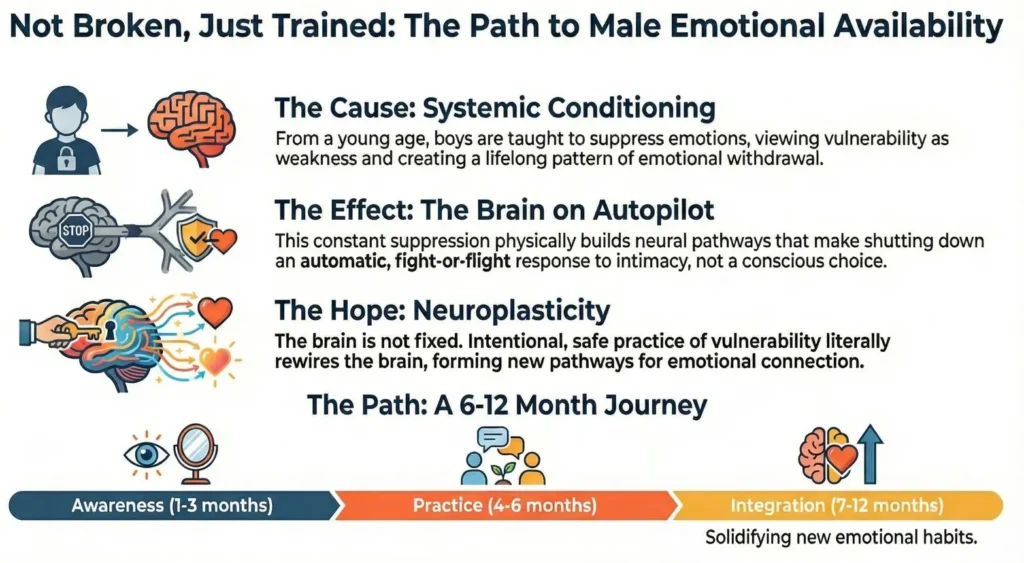
“Male emotional unavailability isn’t about individual weakness or inability. It’s systemic conditioning. It starts young.” Research on masculine socialisation, APA
It’s not about individual weakness or inability. It’s systemic conditioning. It starts young.
Male Socialisation: How Boys Learn to Suppress Emotions
The patterns that surface in adult relationships begin in childhood. By age five, boys have already received consistent messages:
- Emotions are for girls.
- Crying is weak
- Needing help is failure.
- Real men are self-sufficient and unaffected.
These messages come from everywhere. Fathers who model emotional restraint. Peers who mock vulnerability. Teachers who reward boys who “keep it together.” A society that celebrates toughness and punishes tenderness.
Psychologists call this process “masculine socialisation,” and research shows it’s remarkably consistent across demographics. Boys internalise that their value comes from what they produce—how strong they are, what they achieve, and whether they can be depended on. They’re taught to see themselves as functions rather than whole people.
By adolescence, this gets reinforced through what researchers call “masculinity policing.” Other boys test whether a peer will cry, express fear, or admit confusion. The ones who flinch get mocked. The ones who stay stoic get respect. This peer enforcement is brutal and effective.
The result: Adult men who literally cannot identify what they’re feeling. They experience emotions as physical symptoms—chest tightness, exhaustion, irritability—without understanding that these are emotional signals. Psychologists call this “normative male alexithymia.” It’s not an inability to feel. Its inability to recognise and name feelings.
Research from the American Psychological Association shows this pattern creates a lifelong habit. By the time men reach adulthood, emotional suppression has become automatic and not chosen. Automatic.
The Neuroscience: How Patterns Become Hardwired (And Why Change Is Possible)
Here’s where it gets hopeful.
The brain is not fixed. Neural pathways are physical structures that can reorganise. This is neuroplasticity, and it’s one of the most significant discoveries in neuroscience of the past 20 years.
When a man suppresses emotions repeatedly throughout childhood, he’s literally building neural pathways for suppression. The limbic system (where emotions are generated) becomes disconnected from the prefrontal cortex (where decision-making happens). When vulnerability triggers arise, the amygdala perceives them as threats. The nervous system goes into a fight-or-flight response, and the man withdraws.
Over time, this becomes his default. He’s not choosing withdrawal. His nervous system is choosing it for him.
But here’s the critical insight: These pathways aren’t permanent. Brain imaging studies show that when men engage in consistent vulnerability practice with safe people, new neural pathways form. The limbic-prefrontal connection rewires. Vulnerability stops triggering fight-flight.
| Brain Response | Without Development | With Practice |
| When vulnerability arises | Amygdala triggers fight-flight | Prefrontal cortex engages; nervous system stays calm |
| Physical sensation | Chest tightness, urge to escape | Mild discomfort, manageable |
| Time to recover | Hours or days of avoidance | Minutes of staying present |
| Relationship impact | Withdrawal, distance | Connection, intimacy |
Evidence for neuroplasticity comes from unexpected research: studies on fatherhood. When men become fathers, their brains actually change. Grey matter increases in regions involved in emotional processing and empathy. Fathers show greater activation in social-emotional brain regions. Their brains aren’t the same after repeated exposure to vulnerability and emotional responsiveness.
If fatherhood can rewire a male brain, so can intentional practice. So can therapy. So can a supportive partnership.
The timeline matters. Changes in neural pathways don’t happen overnight. But they do happen.
Attachment Styles: Understanding Avoidant Attachment in Men
Attachment theory provides another lens for understanding male emotional unavailability.
Attachment describes how people relate to intimacy. About 25% of the population develops “avoidant attachment”—meaning they fear closeness and typically withdraw when intimacy increases. Men score significantly higher on avoidant attachment measures than women.
Avoidant attachment develops when a child learns that expressing needs doesn’t elicit a response. The parent is emotionally unavailable, dismissive, or punishing. So the child learns: “I can’t rely on others. I need to be independent. I need to manage alone.”
This served a survival purpose in childhood. But in adulthood, it creates a relationship disaster. Here’s why:
When a partner seeks emotional connection, an avoidantly attached man experiences this as a threat to his independence. His nervous system goes into protective mode. He withdraws. The more his partner pursues, the more he retreats.
Researchers call this the “demand-withdraw” cycle, and it’s one of the most damaging patterns in relationships:
→ Partner seeks emotional connection
→ Man experiences this as suffocation
→ Man withdraws
→ Partner feels rejected and pursues harder
→ Man retreats further
→ Both partners end up miserable
Breaking this pattern requires the avoidantly attached person to have repeated experiences of vulnerability and safety. Not scary. Safe. The nervous system needs corrective experiences—moments when he opens up and isn’t punished, dismissed, or abandoned.
The good news: Secure attachment can be developed at any age. It’s not fixed.
Normative Male Alexithymia: The Hidden Foundation
Alexithymia means difficulty identifying and describing emotions. The “normative” version exists in many men because of socialisation patterns, not a psychological disorder.
An alexithymic man might:
• Feel his chest tighten during an argument but interpret it as anger rather than hurt
• Avoid social situations and call himself introverted when actually he’s anxious
• Work 80-hour weeks and call himself driven when actually he’s escaping depression
He’s not lying. He genuinely hasn’t developed the ability to translate physical sensation into emotional vocabulary.
This creates a catch-22. A woman might ask, “What are you feeling?” and he has no answer. Not because he’s unwilling. Because he literally hasn’t developed the ability to name what he’s experiencing.
The fix is simple but requires practice: emotional labelling. Naming feelings. At first, it feels artificial (“I feel… sad?” said like a question). With repetition, it becomes natural.
The research on this is detailed: men who practice identifying emotions develop better emotional availability. The capacity exists. It just needs activation.
Intersectionality & Generational Context: Not All Men Are The Same
Male emotional patterns vary dramatically across generations, races, and cultures. Ignoring this creates false narratives.
Generational Shifts: Why Gen Z Is Different
Boomers were taught “real men don’t cry.” Millennials started questioning that. Gen Z is actively redefining strength.
| Generation | Core Message | Outcome |
| Boomers | “Real men are stoic” | Widespread emotional suppression, high isolation |
| Gen X | “Be tough; feelings are private” | Mixed messaging; some shift toward emotional openness |
| Millennials | “EQ matters; therapy is normal” | Increased emotional vocabulary; still battling masculine norms |
| Gen Z | “Emotional intelligence is a strength” | More openness to vulnerability; redefining masculinity |
In 2025, data from Bumble showed 31% of American men reported being more emotionally vulnerable than previous generations. Gen Z men grew up with therapy language, watched male celebrities discuss mental health, and see emotional intelligence as a competitive advantage in relationships, not a liability.
This isn’t universal. But the shift is fundamental.
Why the difference? Gen Z was raised by Millennial and Gen X parents who parented differently than their own parents. They encountered therapy culture earlier. They had more permission to discuss emotions. They saw that the “strong, silent type” often led to isolation and pain.
“The men my age actually know how to talk about feelings. My mom’s friends are jealous.” Gen Z woman describing her dating experience
Millennial women increasingly prefer Gen Z men for precisely this reason. One Gen Z woman shared: “The men my age actually know how to talk about feelings. My mom’s friends are jealous.”
But here’s the complexity: Gen Z faces different barriers. They grew up with social media and less face-to-face intimacy. Many experience emotional detachment as a protective mechanism, even as they develop a richer emotional vocabulary.
Older men aren’t broken; they were socialised differently. That socialisation created patterns, not fixed traits.
Racialised Masculinity: Why Black Men Face Compounded Barriers
Race shapes emotional expression differently. Black men navigate a unique intersection of racist stereotypes and masculine conditioning.
The stereotype of the angry Black man is pervasive and dangerous. A Black man expressing legitimate frustration gets coded as threatening. A Black man showing vulnerability gets coded as weak. There’s no safe way to be emotionally expressive.
Research on racialised masculinity shows that Black men navigate systemic racism while enforcing masculine norms on themselves. The “public regard” (how others perceive them) combined with “private regard” (how they see themselves) creates a double bind. Many internalise the belief that vulnerability is incompatible with being a Black man in a society that perceives Black men as threats.
This isn’t universal. But the barriers are real and distinct from what white men experience.
African-centred worldviews offer a counterbalance, emphasising interdependence, communal well-being, and emotional expression. Communities that reclaim these values create more space for emotional availability.
The point: Understanding a man’s emotional patterns requires understanding his full context.
For Women: How to Identify Emotionally Available Men (8 Clear Signs)
Okay. You understand why men struggle. Now let’s get practical.
If you’re evaluating whether a man is emotionally available, look for these eight observable signs. These aren’t about words. They’re about consistent behaviour.
Sign 1: He Asks Meaningful Questions and Actually Listens
An emotionally available man asks about your inner world, not just logistics. He remembers details. He brings up something you mentioned weeks ago. When you talk, he’s actually present—not planning his response while you speak.
Watch for:
- Does he put his phone away?
- Does he make eye contact?
- Does he ask follow-up questions?
- Does he remember things you tell him?
The opposite: He asks “How was your day?” out of obligation but isn’t actually interested in the answer. Conversations stay surface-level. You feel like you’re talking to a wall.
Sign 2: He Shares His Own Feelings and Thoughts Freely
This isn’t performative vulnerability. It’s natural. He mentions when he’s tired, frustrated, excited, or nervous. He doesn’t hide his inner world.
This doesn’t mean he’s constantly emotional. It means he doesn’t see feelings as weakness. He references his emotional experience as if it’s normal, because to him it is.
The opposite: He claims he “doesn’t get emotional” or “doesn’t really feel that much.” Every conversation about feelings gets redirected. You sense a wall between you.
Sign 3: He Has Other Meaningful Relationships (Not Just Romance)
Look at his friendships. Does he have close friends he confides in? Does he maintain relationships beyond romantic partnerships?
An emotionally available man has a support system. Not because he needs it (though he does), but because he values connection. Men with robust friendships tend to be more emotionally available in romantic relationships.
The opposite: He’s isolated. His female partner is his only source of emotional support. He has acquaintances but no close friends. This puts an unrealistic burden on the relationship.
Sign 4: He Stays Present in Difficult Conversations (Doesn’t Withdraw)
When conflict arises, does he stay? Does he get momentarily defensive, then come back to the conversation? Does he want to work through tension rather than escape it?
Watch what happens when you express anger or sadness. Does he try to fix it immediately, dismiss it, or disappear? Or does he stay, listen, and sit with your feelings even when uncomfortable?
An emotionally available man can tolerate tension without needing to resolve it immediately. He doesn’t withdraw when things get hard.
The opposite: He shuts down. Every difficult conversation becomes a source of panic for him. He stonewalls, leaves, or changes the subject. You feel alone in your feelings.
Sign 5: He’s Honest About Mistakes and Takes Responsibility
When he messes up, does he acknowledge it? Does he apologise genuinely? Does he work on not repeating the behaviour?
Emotionally available men can sit with guilt and shame without defending. They don’t make excuses endlessly. They own their behaviour and change.
The opposite: He gets defensive. He finds reasons why you’re actually the problem. He blames circumstances. You never get a genuine apology.
Sign 6: He Shows Consistent Follow-Through (Actions Match Words)
Does he do what he says? Does he follow up on commitments? Is he reliable?
This is simpler than it sounds. Actions reveal priorities. An emotionally available man makes his partner a priority. Not constantly, but consistently.
The opposite: He makes promises he doesn’t keep. His actions contradict his words. You can’t trust what he says.
Sign 7: He’s Curious About Your Inner World, Not Just Logistics
He asks about your dreams, your fears, your values, and what brings you joy. He wants to know who you are, not just what you do.
The opposite: Conversations stay at the surface. He doesn’t ask personal questions. You don’t feel known.
Sign 8: He Can Handle Your Emotions Without Dismissing Them
When you’re sad, angry, or scared, does he meet you there? Or does he try to “fix” it, minimise it, or dismiss it?
An emotionally available man can tolerate his partner’s emotions. He doesn’t see them as problems to solve. He sees them as valid experiences to honour.
The opposite: He gets impatient with your feelings. He tells you to calm down or get over it. You hide your emotions around him.
The Pattern That Matters Most
Notice something: These signs aren’t about grand gestures. They’re about consistent presence and responsiveness in small moments.
One woman described it perfectly: “The difference isn’t that he’s always perfect. It’s that when I’m struggling, I know he’ll actually be there.”
For Men: The Development Pathway to Emotional Authenticity (6-12 Month Timeline)
If you’ve read this far and recognised yourself in the patterns I’ve described, here’s the good news: You can change.
I want to be specific about this because vague assurances (“Just be vulnerable!”) don’t help. Real change requires understanding the process.
Why Your Brain Can Actually Change: The Neuroscience of Neuroplasticity
Fatherhood research provides striking evidence. When men become fathers, their brains physically change. Grey matter increases in regions involved in emotional processing. Brain imaging shows increased activation in regions associated with empathy and social awareness.
These aren’t small changes. They’re structural reorganisation of the brain.
If parenthood can rewire a male brain, so can intentional practice. So can therapy. So can a committed partnership where you repeatedly choose vulnerability and experience it as safe.
The mechanism: Each time you experience vulnerability without punishment or abandonment, your nervous system updates its threat assessment. The fight-flight response weakens. New neural pathways strengthen.
But here’s the realistic part: This takes time. Not years necessarily, but months of consistent practice. Your brain built these suppression pathways over the course of 20+ years. Rewiring takes intention.
The 3-Phase Development Timeline
I’ve synthesised research on attachment therapy, men’s transformation groups, and therapy outcomes. This timeline emerges consistently:
Phase 1: Foundation (Months 1-3) — Awareness & Self-Work
This is where most men get stuck because it feels pointless. You’re not seeing external changes yet.
Your main work:
- Develop self-awareness. Start noticing what you feel without immediately pushing it away.
- Work with a therapist if possible—specifically, an attachment-focused therapist who understands masculine conditioning.
- Build self-worth independent of achievement. Many men’s entire identity rests on productivity. You need to develop a sense of value separate from what you accomplish.
- Start practising vulnerability with safe people. Not your romantic partner yet. Start with a therapist, a close friend, or a men’s group. The nervous system needs practice in low-stakes environments.
Expect: This phase often feels uncomfortable. You’re developing new muscles. Emotional conversations might feel awkward.
Timeline reality: Give this at least 3 months. Rushing through causes relapse.
Phase 2: Difficult Work (Months 4-6) — Processing & Micro-Vulnerability
This is the most challenging phase. You’ll start confronting why you suppress emotions in the first place.
Often there’s trauma. An emotionally unavailable father. Peer bullying. A relationship where vulnerability was punished. This phase requires sitting with that pain.
You’ll start “micro-vulnerability”—small acts of emotional sharing:
• Telling a friend you’re scared about something
• Admitting to your partner that you need help
• Saying “I’m uncomfortable” instead of just withdrawing
Each small act of vulnerability followed by acceptance rewires your nervous system. You’re building evidence that vulnerability doesn’t equal destruction.
Expect: This phase is emotionally taxing. You might feel worse before you feel better because you’re actually feeling things you’ve been suppressing for years.
Timeline reality: Give these two months minimum. Don’t rush.
Phase 3: Integration (Months 7-12) — New Patterns Solidifying
By now, vulnerability is becoming more natural. Less scary. You’re recognising the payoff: deeper relationships, less isolation, fewer stress-related physical symptoms.
New patterns are becoming automatic. When conflict arises, you naturally reach toward it instead of away. When your partner expresses emotion, you stay present instead of shutting down.
Your romantic relationship will likely shift significantly during this phase. Your partner will feel the change and respond to it.
Expect: Relief. Freedom. A sense that you’re finally yourself.
Timeline reality: Most men report significant shifts by month 12. Some continue evolving beyond that. This isn’t a destination; it’s a direction.
Timeline Reality Check
Real talk: Some men try this for three weeks, don’t see results, and quit.
The nervous system doesn’t work on a microwave timeline. You can’t feel significantly different in a month when you’ve spent 25 years building these patterns. This is a marathon, not a sprint.
The payoff is worth it, but only if you’re genuinely committed.
Practical Exercises: Start Developing Emotional Availability Today
You don’t need months of therapy to start this work. You can begin today.
Exercise 1: Real-Time Emotional Revealing (The 5-Minute Practice)
This exercise retrains your nervous system to tolerate vulnerability while being observed.
How to do it:
- Set a five-minute timer.
- Sit across from someone you trust (ideally, but not necessarily, your romantic partner)
- Make eye contact
- For five minutes, share your inner experience as it arises. Not a rehearsed story. Your experience right now.
Example: “Being here with you, I notice I’m a bit nervous. Part of me wants to deflect with humour. Underneath that is some vulnerability about whether I’m doing this right.”
You’re putting words to your internal experience in real time. You’re not performing. You’re revealing.
Most men find this awkward initially. That awkwardness is the work. You’re building capacity for discomfort.
Protocol: Do this once weekly for eight weeks. Note how it changes.
Exercise 2: Walking Straight Into Fear (Saying the Hard Thing)
Identify something you’re afraid to say to your partner, to a friend, to a family member.
Examples:
• “I’m scared you’ll leave me if you really know me.”
• “I failed at something I was supposed to be good at, and it’s destroying me.”
• “I need help, and I hate that I need help.”
The thing you’re most afraid to say is often precisely the thing that will deepen your relationship.
State it once. Don’t take it back. Don’t qualify it. Let it sit.
Why it works: This rewires your nervous system. It teaches you that the catastrophe you fear doesn’t happen.
Exercise 3: Coming Out of Hiding (Embodying Your Full Self)
Ask yourself: What parts of myself do I hide? What would I be if I weren’t trying to be strong?
Maybe it’s your sensitivity. Maybe it’s your creativity. Maybe it’s your doubt.
Practice bringing those parts into your relationships. Not performatively. Genuinely.
If you’re sensitive and you typically hide that, start letting people see it. If you doubt yourself and you always fake confidence, start admitting the doubt.
Why it works: This integrates disowned parts of yourself. The nervous system learns that your whole self is acceptable.
Where to Find Support: Therapy, Men’s Circles & Community
Real change happens in a relationship. You need people.
Individual Therapy: Attachment-Focused Approaches
Look for a therapist trained in attachment theory. Not just someone who will listen sympathetically, but someone who understands how attachment wounds form and how to create corrective experiences.
What to look for:
- A therapist who teaches you skills, not just processes your feelings.
- Someone who can name what’s happening (“That’s your fight response kicking in”)
- Someone who helps you develop alternatives
Cost: Varies. Many therapists offer a sliding scale. Some online therapy platforms (BetterHelp, Talkspace) are more affordable than traditional therapy.
Timeline: You should see shifts within 8-12 sessions if it’s a good fit.
Men’s Circles: The Underrated Option
Men’s circles are small groups (typically 8-9 men) that meet regularly over 8-12 sessions. The structure is specific: vulnerable sharing, witnessing, and deep listening without fixing.
Why they work: Most men have never witnessed other men being vulnerable. The experience of sitting in a circle with guys who admit fear, cry, share pain, and get supported (not mocked) is transformative. It rewires what’s possible.
A typical circle arc moves through four directions:
| Direction | Focus | Timeframe |
| South | Vulnerability, safety building | Sessions 1-2 |
| West | Courage, action, personal power | Sessions 3-4 |
| North | Reflection, awareness, integration | Sessions 5-6 |
| East | Integration, action, commitment | Sessions 7-8 |
Cost: Usually $200-$600 for an 8-week series, depending on location.
Find them: Search “men’s circles” or “men’s healing groups” in your area. Many therapists facilitate them.
Online Communities & Resources
These are supplements, not replacements. They provide accountability and connection but lack embodied presence.
Options:
- Reddit communities like r/emotionalintelligence and r/menshealth have thoughtful discussions.
- Online courses on attachment theory can build knowledge.
- Forums focused on men’s personal development and vulnerability.
Reality check: These help, but aren’t sufficient alone. You need honest people, a tangible presence.
Common Barriers & How to Overcome Them
Understanding barriers helps you navigate them.
Barrier 1: Workplace Norms (The Professional Cost of Vulnerability)
Most workplaces reward emotional suppression. You get promoted for being stoic and in control. Vulnerability gets coded as weakness.
This creates a split: a professional persona (controlled, unaffected) and a personal self (struggling, emotional). Maintaining this split is exhausting.
Solution: Find safe spaces for vulnerability outside work. Let your professional identity be professional without requiring you to suppress your humanity. Some leaders are shifting this. Seek those out if possible.
Barrier 2: Friendship Patterns (Male Friendships Are Structured ‘Side-by-Side’)
Male friendships are typically activity-based. You go to sports events, play video games, and grab drinks. You don’t sit down and share deeply.
This isn’t innate. It’s structural. But it means most men lack practice in intimate friendships.
Solution: Take initiative. Invite a friend to coffee and say, “I want to talk about something real.” You might be surprised how willing he is. Most men are starving for this.
Barrier 3: Fear of Weakness (Reframing Vulnerability as Strength)
The deepest barrier is the belief that vulnerability equals weakness.
It doesn’t.
Vulnerability is acknowledging reality. Strength is facing reality without defence. Courage is admitting fear and moving forward anyway.
The most powerful people I know are vulnerable. They don’t see emotions as data points. They see them as part of being human.
Solution: Expose yourself to men who model emotional strength. Find role models who are both tough and tender. Gen Z men. Male therapists. Male artists and musicians who discuss their emotional lives.
Why This Matters: The Real-World Impact of Emotional Availability
Understanding the mechanics is helpful. But understanding the payoff is what drives change.
Impact on Relationships: What Emotional Availability Creates
Emotional intimacy directly predicts relationship satisfaction. This isn’t theoretical. This is repeatedly demonstrated in attachment research.
When a man is emotionally available, his partner reports:
✓ Feeling genuinely seen and known. Not performed for. Truly understood.
✓ Safety to be herself. She doesn’t have to minimise or hide her experience. She can be fully human.
✓ Deeper physical intimacy. Emotional availability creates a sense of safety for physical vulnerability. Sex becomes more connected, less transactional.
✓ Reduced anxiety. She stops wondering whether he cares. His presence answers the question.
✓ A relationship that feels sustainable. She stops thinking about leaving because the fundamental need for emotional connection is met.
Impact on Parenting: Breaking Generational Cycles
Children with emotionally available fathers show:
| Factor | Outcome |
| Emotional regulation | Better able to identify and tolerate emotions; don’t escalate as quickly |
| Academic achievement | 43% higher rates of academic success |
| Social skills | Know how to navigate relationships; have models for vulnerability |
| Mental health | Lower rates of depression, behavioral problems |
| Generational impact | Less likely to continue the suppression cycle |
One emotionally available father breaks the pattern for his children and their children. The generational shift starts with you.
Impact on Your Own Mental Health
Emotional suppression has serious health costs. Research links it to depression, anxiety, high blood pressure, and immune system dysfunction.
When you practice emotional availability:
→ Depression and anxiety decrease (you’re processing emotions instead of storing them)
→ Physical health improves (lower stress = lower cortisol = real physical improvements)
→ Sleep quality improves (you’re not processing suppressed emotion all night)
→ Sense of purpose increases (you’re connecting authentically with people who matter)
The Workplace Multiplier Effect
Leaders’ emotional availability affects entire teams. When a leader is honest about challenges, admits mistakes, and shows presence, teams feel safer—psychological safety increases. Vulnerability in leadership, within appropriate bounds, makes teams more effective.
FAQ: Your Most Common Questions Answered
Q: Can emotionally unavailable men actually change?
A: Yes. Neuroscience is clear: brain plasticity enables change at any age. But it requires commitment, usually 6-12 months of consistent work, and often professional support. Change is possible. It’s not automatic.
Q: How long does it actually take to see fundamental changes?
A: Months 1-3, you might not see dramatic external changes. You’re building a foundation. Months 4-6, your partner and friends start noticing. By month 12, most men report significant shifts. But development continues beyond that.
Q: What if my partner won’t try to become more emotionally available?
A: That’s a decision point. You can pursue therapy for yourself to develop your own boundaries and attachment security. You can have a direct conversation about your needs. You can accept that he is who he is. Or you can leave. These are your real options. But you can’t make him change.
Q: Is emotional availability the same as being expressive or talkative?
A: No. Many expressive people are emotionally unavailable. Emotional availability is about genuine inner access and responsive presence, not about talking a lot or showing emotion.
Q: Do I need to change myself to be with an emotionally available man?
A: You may benefit from personal work (therapy, understanding your attachment). But a genuinely emotionally available man should make you feel safer being yourself, not requiring you to change fundamentally.
Q: Where do I actually meet emotionally available men?
A: Less about where and more about what to notice. Look for men in therapy communities, grief support groups, men’s circles, or those explicitly interested in personal growth. Avoid men who boast about “needing no one.”
Conclusion
Here’s the simple truth: Emotional unavailability in men isn’t a fixed trait. It’s a learned pattern created by decades of socialisation, reinforced by nervous system responses, and maintained by a lack of corrective experiences.
The key insight: Your brain can change. At any age. With consistent practice and safe relationships.
For women reading this: Understanding the roots of male emotional unavailability shifts everything. It doesn’t excuse behaviour. It explains it. You can distinguish between men who are unwilling to grow and men who are scared but trying.
For men reading this: You’re not broken. You were trained. And what was trained can be retrained. The pathway is concrete. It requires courage, but it leads to a completely different kind of life. Relationships that are real. Friendships that matter. Presence instead of performance.
“The most important thing about emotional availability isn’t that it makes you a better partner. It’s what makes you feel alive.” — Research on emotional wellness and relationship quality.
The most important thing about emotional availability isn’t that it makes you a better partner. It’s what makes you feel alive.
Ready to Take the Next Step?
If you’re a woman seeking to break patterns of attracting emotionally unavailable men:
Our free “Checklist” helps you evaluate whether the men you’re considering are genuinely available or performing. Join our newsletter to download it instantly.
If you’re a man ready to develop emotional authenticity:
For anyone interested in deeper work, we recommend:
• “Attached” by Sue Johnson and Amir Levine — Understanding attachment patterns
• “Daring Greatly” by Brené Brown — Reframing vulnerability as strength
• Local men’s circles — Find one in your community
Emotional authenticity is possible for every man. And every woman deserves a partner capable of it.