

How to Know If Your Partner Is Trustworthy: A Stage-by-Stage Guide for Women
You’ve felt it before: that moment of doubt when you’re wondering, “Is he actually trustworthy, or am I missing something obvious?” Maybe his charm is overwhelming, or maybe he’s shown minor inconsistencies that nag at you. Or perhaps you’re haunted by a past relationship where you didn’t see the red flags until it was too late.
Assessing trustworthiness in dating is neurologically difficult. Your brain is flooded with dopamine and other attraction chemicals that literally reduce your ability to think clearly. And if you’ve been hurt before, trauma can cloud your judgment, making you either too trusting or too suspicious.
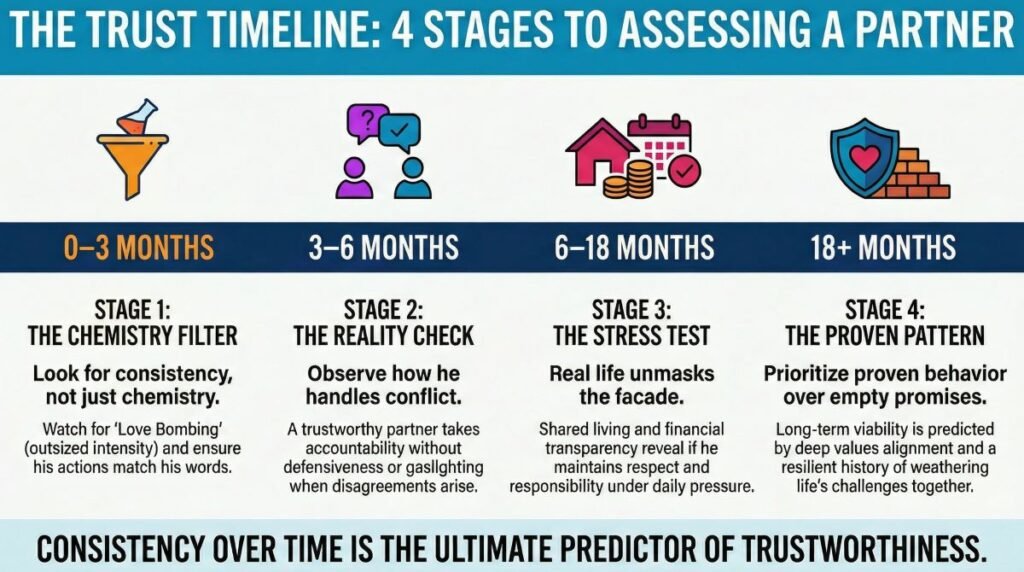
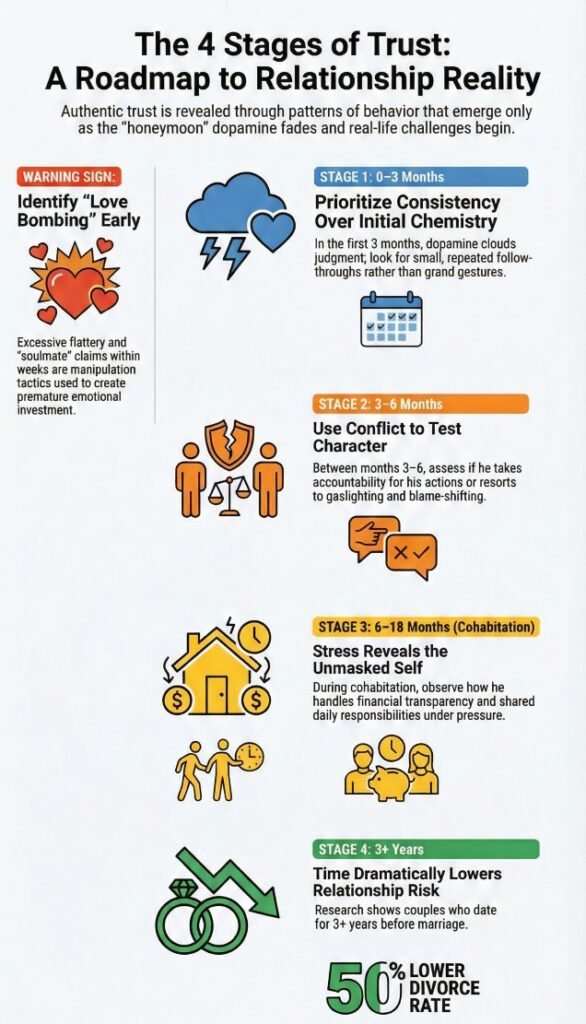
This guide breaks down exactly what trustworthiness looks like across four distinct relationship stages, from that first exciting date through marriage readiness. Rather than generic lists of “signs,” you’ll get a stage-specific framework you can use to assess your partner’s character at every phase systematically.
This framework synthesizes relationship research from the Gottman Institute, attachment theory, and psychology studies on trust, combined with practitioner expertise on manipulation, gaslighting, and relationship dynamics.
Why Assessing Trustworthiness Matters: The Foundation of Healthy Relationships
Trust is the cornerstone of every fulfilling relationship. Without it, you’re building on sand. Yet for most women, distinguishing genuine trustworthiness from sophisticated manipulation feels impossible.
The cost of poor assessment is high. Women who ignore red flags often spend years in draining relationships—those who are overly suspicious due to past trauma miss genuinely trustworthy partners. The sweet spot is clear-eyed assessment based on actual behaviour, not hope or fear.
Trust as the Foundation of Healthy Relationships
Trust predicts relationship satisfaction better than almost any other factor. Research shows that couples who trust each other deeply report 80% higher life satisfaction. Yet trust isn’t built instantly. It’s revealed through consistent behaviour over time.
The challenge: you must assess trustworthiness at each stage of your relationship with limited data and an unreliable brain state.
Why Early Assessment Matters: The Cost of Delayed Judgment
The longer you wait to assess someone’s trustworthiness, the harder it becomes. After three months of regular contact, you’ve developed emotional attachment, oxytocin bonding (the “love hormone”), and investment in the relationship. By month six, walking away feels impossible, even if red flags appear.
This is why early, honest assessment matters. It’s not cynical; it’s self-protective.
The Neuroscience of Early Attraction: Why Your Brain Makes Judgment Difficult
When you meet someone attractive, your brain floods with dopamine (the “reward” chemical) and norepinephrine (which increases focus and memory). This is the famous “honeymoon phase.” Your prefrontal cortex, the part responsible for logic and judgment, literally becomes less active. You’re neurologically less capable of seeing red flags during weeks 1-8.
Around week 12-16, dopamine levels drop. Reality emerges. This is when authentic behaviour starts showing through the facade.
Understanding this biology helps you extend grace to yourself if you initially miss warning signs. You weren’t being stupid. Your brain was chemistry-hijacked.
Stage 1: Early Dating (Dates 1-8, First 0-3 Months): What to Assess When Chemistry Clouds Judgment
The first three months are a chemistry storm. Your dopamine is high, your judgment is low, and everything feels possible. This is the hardest stage to assess trustworthiness accurately, and the most critical.
The Dopamine Phase: Why Early Dating Assessment Is Neurologically Difficult
During early dating, your brain prioritises attraction over truth. You notice things he does well and minimise things that seem “off.” A broken promise feels like an exception; consistent follow-through feels normal. Your brain is literally working against honest assessment.
This isn’t a weakness; it’s biology. But understanding it helps you build assessment systems that work despite your brain state.
The antidote? Look for consistency, not just chemistry. Chemistry fades. Consistency either increases or decreases.
What to Assess on Your First Date: Energy, Presence & Emotional Safety
Forget memorising a checklist of traits. Instead, notice three things:
First, his energy and presence. Is he grounded, playful, or tense? Does he make eye contact? Research from McGill University found that first impressions are accurate. People with higher self-esteem and well-being tend to be more authentic and easier to read. If he feels authentic, that’s data.
Second, genuine curiosity. When you share something about yourself, does he ask genuine follow-up questions? Or does he wait for his turn to talk? Someone who listens with genuine interest is showing respect.
Third, how you feel post-date. This is the most important assessment tool. After you leave, ask yourself:
- Did you feel energised or drained?
- Did you feel seen and heard, or invisible?
- Did you feel safe being yourself, or did you feel you needed to perform?
- Were you excited to see him again, or uncertain?
Your emotions are data. If you feel confused, anxious, or overly scrutinised, that’s essential information. You may not yet articulate why, but trust that feeling.
Green Flags in Early Dating: Signs of Genuine Trustworthiness
Consistency between words and actions. He says he’ll text you, and he does when he says he will. He says he wants to see you again, and he follows through with concrete plans, not vague “we should hang out sometime.”
This might sound basic, but it’s one of the strongest predictors of trustworthiness. Consistency requires follow-through, not just charm.
Honesty about his feelings. He admits when he’s nervous about the date. He talks openly about what he’s looking for. He doesn’t pretend to feel something he doesn’t. When he doesn’t know something, he says “I don’t know” instead of making things up.
Respect for your pace. When you say you want to take things slow, he respects it. He doesn’t pressure you for physical intimacy. He asks before assuming consent or comfort.
Signs of genuine self-esteem. He doesn’t need excessive reassurance. He can laugh at himself. He doesn’t put you down to feel better. He shows genuine confidence without arrogance.
Critical Early Red Flags: Love Bombing, Boundary Pushing & Inconsistency
Love bombing is the most dangerous early red flag. It’s excessive attention, flattery, and expressions of love that feel outsized compared to how long you’ve known each other. This includes:
- Overwhelming compliments before you’ve spent real time together
- “I love you” or “You’re my soulmate” within weeks.
- Constant texting, messaging, wanting to be together
- Plans that escalate too quickly (meeting family, moving in together, engagement)
Love bombing isn’t always obviously bad; it can feel wonderful. But it serves a purpose: it creates emotional investment before someone’s character can be assessed. When the intense attention inevitably shifts, you’re already too emotionally involved to leave.
Boundary pushing signals a lack of respect. This includes:
- Wanting to move off the dating app too quickly (before patterns emerge)
- Requesting explicit photos early on
- Pressuring for physical intimacy before you’re ready
- Not respecting when you say “no” or “not yet”
- Asking intrusive personal questions before building rapport
Someone who respects your boundaries, even when disappointed, is showing trustworthiness. Someone who minimises your hesitation (“Come on, loosen up”) is showing the opposite.
Inconsistency is the clearest early warning sign. He says one thing but does another. His story about his job, ex, or intentions changes. He acts differently around you than around others (overly nice to you, rude to service workers). He can’t explain simple inconsistencies without getting defensive.
Consistency is difficult to fake long-term. Inconsistency early signals dishonesty or divided attention.
Excessive charm and perfection. He seems too good to be true, because he is. He has an answer for everything. He never gets upset or frustrated, and he doesn’t show real emotion. He pivots away from any conversation that might reveal flaws.
Real humans are flawed and have complex emotions. Someone who never shows vulnerability or admits mistakes is either hiding something or cannot be trusted with your vulnerability.
The Post-Date Assessment: How You Feel as Data
After your first date, sit quietly and reflect. Not on what you want to feel, but what you actually feel.
Excited about the next date? That’s positive. Confused about where things stand? Note it. Drained after spending time together? That’s information. Did he make you feel seen, or did he make you feel like you needed to prove yourself?
Your gut knows things your brain hasn’t articulated yet. If you feel unsafe, anxious, or “off” around someone, that’s worth investigating, not dismissing.
Stage 2: Exclusive/Committed Dating (3-6 Months): The Reality Check When the Facade Fades
After about three months together, the dopamine high begins to fade. The real person starts emerging. If there are significant red flags, they often appear then.
This stage is critical. It’s long enough to see patterns but early enough to exit if something feels fundamentally wrong.
The Fade from Euphoria: What Changes Around Month 3-4 (And Why)
Around month four, you’ve dated enough times that he stops needing to “perform.” The effort to maintain a facade becomes exhausting. His default personality emerges. His true priorities become visible. How he handles everyday frustration reveals character.
This isn’t necessarily when he “changes.” It’s when you see who he actually is beneath the initial attraction.
Pay attention to this transition. If he was consistently warm and present, does he remain so? Or has he become distant, less communicative, more withdrawn? If he was respectful of your boundaries, does that continue? Or does he start “testing” limits?
How He Handles Disagreement: The Most Telling Assessment
You’ll have your first real conflict during this stage. Pay close attention to how he handles it.
- Does he blame you entirely, or can he see his part?
- Does he attack you personally, or address the specific issue?
- Can he listen to your perspective without becoming defensive?
- Is he willing to apologise and make changes?
The way someone argues tells you everything about their capacity for partnership. Someone who can’t hear feedback, takes everything personally, or blames you for his feelings will never build deep trust with you.
Emotional Vulnerability & Emotional Availability: Can He Let You In?
A trustworthy partner is willing to be emotionally vulnerable. This requires courage. He shares his fears, disappointments, and struggles. He lets you support him. He doesn’t insist on handling everything alone.
Someone who walls off emotions or dismisses yours is signalling that they cannot be trusted with your heart.
Ask yourself:
- Can he share his feelings without you having to ask repeatedly?
- Does he let you support him, or does he insist on handling everything alone?
- Can he admit when he’s scared, hurt, or struggling?
- Does he create space for your emotions, or does he minimise them?
His Relationship History: What His Exes Tell You About Him
Can he speak honestly about his exes without excessive bitterness? Does he take responsibility for his part in relationship breakdowns, or does he blame “crazy exes”? Is he open about his relationship history? Does he show insight into his own patterns?
Someone who blames every ex for relationship failures hasn’t done the self-reflection necessary to be a trustworthy partner. This is a major red flag. It suggests he can’t see his own role in problems, which means he’ll do the same things again.
Escalating Red Flags During Exclusivity: Gaslighting, Jealousy & Control
Gaslighting is when your partner makes you question your own reality. Common examples:
- “That’s not what I said” (when you have a clear memory of it)
- “You’re too sensitive” or “You’re overreacting” (minimising your legitimate concerns)
- “I never said that” (denying something that definitely happened)
- “You’re crazy” (attacking your sanity instead of addressing the issue)
Gaslighting is psychological abuse designed to erode your confidence in your own judgment. It often escalates over time, starting with small denials and building until you don’t trust your own memory.
Jealousy and control are escalating:
- Checking your phone without permission
- Getting upset when you spend time with friends
- Accusatory questions about who you’re talking to
- Possessiveness framed as love (“I just love you so much, I need to know where you are”)
Jealousy is not a sign of love. It’s a sign of insecurity and a need for control.
Mood swings and unpredictability. He’s wonderful one moment, cold or angry the next. You feel like you’re walking on eggshells, trying not to upset him. His moods seem to change without apparent reason. You’re constantly adjusting your behaviour to manage his emotions.
This creates anxiety and confusion, which is often the point. It keeps you off-balance and more compliant.
Green Flags That Build Confidence: Accountability, Communication & Growth
Accountability without defensiveness. When you raise a concern, he listens rather than immediately defending himself. He can say, “You’re right, I shouldn’t have done that.” He explains his perspective without blaming you. He follows through on changes he commits to.
Emotional investment. He makes plans ahead. He initiates date nights and conversations. He checks in on your day, your feelings, and your well-being. He remembers important dates and details.
Healthy communication about the future. He naturally talks about you in his plans. He’s curious about your goals and wants to support them. He can have the “where is this going” conversation without defensiveness. He’s clear about what he wants: exclusivity and commitment.
Stage 3: Cohabitation & Serious Commitment (6-18 Months): Living Together Reveals What Words Hide
Research shows that 52% of American couples believe 6-18 months is the ideal timeline for moving in together. This stage is crucial because living together removes the ability to maintain a facade. You see how someone handles stress, conflict, daily responsibilities, and domestic life, not just romantic moments.
Why Moving In Together Reveals Truth: The Facade Can’t Be Maintained Daily
Living together, you see:
- How he behaves when tired, frustrated, or under pressure
- His actual priorities (does he spend time on what he says matters?)
- How he handles household responsibilities
- How does he deal with everyday inconveniences?
- What he’s really like without an audience
You can’t perform every day. Neither can he. This is where authentic character emerges.
Daily Behaviour Patterns: Consistency Under Real-Life Stress
Watch for patterns over weeks and months:
- Does he maintain respect and kindness during stress?
- Or does he become withdrawn, critical, or cold?
- When tired, does he still contribute to household life?
- Or does everything fall on you?
- Does he follow through on what he says he’ll do?
- Or do broken promises pile up?
Consistency under stress is the strongest predictor of trustworthiness at this stage. Anyone can be nice when life is easy.
Financial Transparency & Responsibility: How Money Reveals Character
Money conversations are essential. Ask:
- Is he open about his financial situation?
- Does he contribute fairly to household expenses?
- Is he responsible for his own finances?
- Can you have conversations about money without defensiveness?
- Does he hide purchases or financial information from you?
Financial dishonesty and a lack of transparency are significant indicators of a lack of trust. How he handles money reveals his values and respect for partnership.
Division of Labour & Fairness: Does He Respect Partnership Equally?
Are household responsibilities shared equitably, or do you do most of the work? Does he pull his weight, or do you feel like you’re managing him? When you bring up unfairness, does he make changes?
Resentment about unequal household labour is one of the most common relationship complaints. If he dismisses your concerns about fairness, he’s signalling that your perspective doesn’t matter to him.
Stress Response & Emotional Regulation: Who Is He When Things Get Hard?
When stressed (work crisis, family problem), how does he behave?
- Does he blame you or take responsibility for his mood?
- Can he calm himself, or does he need you to manage his emotions?
- Does he support you during your stressful times?
- Or does he become withdrawn or critical?
How someone behaves under stress reveals their true character. A trustworthy partner shows up during hard times, not just easy ones.
Red Flags Escalating at Cohabitation: Control, Blame-Shifting & Withdrawal
Control escalation. He monitors your comings and goings. He controls finances or access to money. He tells you what to wear or how to look. He forbids you from seeing friends or family.
These are textbook abuse patterns. If they appear during cohabitation, they will worsen.
Blame-shifting. Nothing is ever his fault. When you address a problem, he turns it around to blame you. He brings up unrelated past issues instead of addressing current problems. He makes you feel like you’re the problem, not his behaviour.
Withdrawal and punishment. When you disagree, he gives you the silent treatment. He withdraws affection as punishment. He threatens to leave or withhold commitment if you don’t comply. He uses sulking or coldness to control you.
Green Flags That Signal Long-Term Viability: Partnership Mindset & Growth
Partnership mindset. When problems arise, he says, “How do we solve this?” not “This is your fault.” He considers your needs when making decisions. He’s willing to compromise. He views the relationship as a team project.
Follow through on responsibilities. He does his share of household tasks without being asked repeatedly. He fixes things he promises to fix. He contributes to the finances fairly. He follows through on commitments, big and small.
Emotional constancy. Even during stress or conflict, he treats you with basic respect. His affection doesn’t disappear when you disagree. He’s still interested in your day, your feelings, your life. You feel like you’re on the same team.
Stage 4: Marriage-Ready & Long-Term Commitment (18+ Months+): Proven Trustworthiness Over Time
By 18+ months, you’ve now:
- Seen each other through multiple seasons and situations
- Navigated conflict and resolved it (or not)
- Made financial decisions together
- Managed shared living space
- Dealt with stress, illness, disappointment
- Introduced each other to family and close friends
- Had honest conversations about the future
The question shifts from “Can I trust him?” to “Is he truly ready for forever?” and “Do I want to build a life with this specific person?”
The Research on Marriage Success: What Actually Predicts Long-Term Viability
Research from the Gottman Institute, which has studied over 3,000 couples, shows clear predictors of divorce. The most significant predictor isn’t conflict; it’s how couples handle conflict.
Couples who can navigate disagreement with respect, listen to each other’s perspectives, and find solutions together tend to thrive. Couples who become defensive, contemptuous, or withdrawn during conflict are at high risk.
Another critical finding: couples who dated for 3+ years before marriage have approximately 50% lower divorce rates than those who dated for only 1 year.
Time matters. Proven behaviour matters more than promises.
Has He Proven Trustworthiness Over Time? Beyond Words to Demonstrated Behaviour
After 18+ months, you should have clear patterns of trustworthiness: not isolated incidents, but sustained behaviour.
Ask yourself:
- Has he consistently shown up when you needed him?
- Has he maintained respect, kindness, and communication even in difficult situations?
- Has he followed through on his commitments?
- Has he handled challenges with maturity?
- Has he shown genuine investment in your well-being and future together?
Promises matter less than patterns. What has he actually demonstrated through sustained behaviour?
Deep Values Alignment: Life Goals, Parenting, Money, Family, Faith
By this stage, you should have clarity on:
| Topic | Questions to Ask Yourself |
| Children | Do you both want them? How many? Parenting philosophy? |
| Career | Will he support your ambitions? How will you handle two careers? |
| Money | Do you align on spending, saving, investing? |
| Family | How much involvement from parents/siblings? |
| Religion/Spirituality | Is this important to both of you? |
| Lifestyle | Do you want to travel? Stay rooted? What matters? |
Couples who haven’t aligned on these major issues don’t have the foundation for marriage. You can’t compromise on wanting children or core values about money. These differences create fundamental incompatibility.
Can He Be Your True Partner? Equality, Support & Mutual Investment
A trustworthy long-term partner:
- Encourages your growth and independence
- Supports your goals even when they don’t directly benefit him
- Treats your opinions with respect, even when he disagrees
- Invests in your wellbeing, not just his own
- Shows up equally in decision-making and problem-solving
If he views partnership as something you owe him, rather than something you build together, he’s not marriage-ready.
Deep Intimacy & Vulnerability: Complete Honesty & Emotional Safety
By this stage, you should feel completely safe being your authentic self. You should be able to:
- Tell him your deepest fears and insecurities.
- Share your failures and disappointments.
- Admit mistakes without fear of judgment or it being used against you.
- Be vulnerable without worrying he’ll weaponise it later.
If you can’t be sincere, you’re not ready for marriage. Deep trust requires being fully seen and accepted anyway.
Red Flags at Marriage Stage: Stalling, Avoidance & Unresolved Issues
Refusing to commit or stalling. He’s been with you 2+ years but won’t discuss marriage. He says “maybe someday” with no concrete timeline. He creates new obstacles (“We need to wait until X happens”). His reasons for not committing are vague or constantly changing.
If he’s not sure after 2+ years, he won’t be sure. And you shouldn’t wait indefinitely for someone uncertain about you.
Unwillingness to address patterns. You’ve raised concerns multiple times, but nothing changes. He acknowledges issues but never actually works on them. He promises to seek therapy or counsel, but doesn’t follow through. He minimises concerns that matter to you.
People don’t change without genuine motivation. Empty promises are red flags, not excuses.
Financial dishonesty. Hidden accounts or spending. Lying about debts. Unwillingness to discuss finances or merge planning. Different financial values that haven’t been resolved.
Money fights are the #1 cause of divorce. If you haven’t solved this, marriage won’t either.
Green Flags That Signal Readiness: Commitment, Vision & Resilience
Deep trust without needing reassurance. You trust him even when he’s not around. You believe him without verification. You don’t need to check his phone or monitor him. You’re confident in his reliability and honesty.
He actively chooses you. He includes you in his plans and decisions. He talks about your future together naturally and specifically. He’s invested in your well-being and success. He shows up consistently, not just when convenient.
You’ve built something resilient. You’ve weathered conflict and come out stronger. You’ve seen each other at your worst and stayed. You’ve navigated stress, disappointment, and change together. You fundamentally trust each other’s commitment to working through problems.
You can imagine real life together. Not just the fantasy version, but the real version: morning routines and everyday mundanities, ageing together, supporting each other through difficulties, building something meaningful that’s bigger than either of you alone.
Red Flags Across All Stages: Recognising Manipulation, Control & Abuse Patterns
Certain red flags matter regardless of the relationship stage. Understanding manipulation tactics helps you recognise them early, before they escalate.
Love Bombing & Excessive Charm: Intensity That Feels Good But Predicts Danger
Love bombing is manipulation disguised as romance. Early intensity predicts danger, not depth.
Signs include:
- Excessive compliments and flattery early on
- “I love you” within weeks of meeting.
- Future planning before you know each other
- Constant contact and desire to merge lives quickly
- Positioning himself as your perfect match
When love bombing stops (and it always does), the withdrawal feels shocking. By then, you’re emotionally invested.
Dishonesty & Inconsistency: The Foundation of Trust Breakdown
Dishonesty takes many forms:
- Lies about small things (his job, past relationships, whereabouts)
- Inconsistency between words and actions
- Vagueness about intentions or commitment
- Hiding information or compartmentalising his life
- Changing his story when questioned
One lie isn’t necessarily a dealbreaker. Patterns of dishonesty signal that trust cannot be built.
Boundary Violations: Early Warning Signs of Control
- Asking to move off dating apps too quickly
- Requesting explicit photos early
- Pressuring for physical intimacy before you’re ready
- Not respecting when you say “no”
- Asking intrusive questions before building rapport
- Snooping (phone, social media, location tracking)
Early boundary violations signal a lack of respect. They often escalate.
Gaslighting: Making You Question Your Reality
Gaslighting is psychological abuse. Common tactics:
| Tactic | Example |
| Denial | “That’s not what I said” (when you have clear memory) |
| Minimizing | “You’re overreacting” (dismissing legitimate concerns) |
| Deflection | Bringing up past issues instead of addressing current problem |
| Character attack | “You’re crazy/emotional/paranoid” |
| Rewriting history | “We never agreed to that” (when you did) |
Gaslighting starts subtly and escalates if unaddressed. It’s designed to make you distrust your own judgment, which makes you more dependent on him for reality.
Isolation & Control: Subtle Tactics That Escalate Over Time
- Criticising your friends or family
- Making you feel guilty for spending time with others
- Creating situations that keep you isolated
- Positioning himself as the only person who truly understands you
- Preventing you from working or controlling your paycheck
- Monitoring your location, phone, or social media
Isolation removes your support system, making you more dependent on him. This is a classic abuse tactic.
Blame-Shifting & Lack of Accountability: Never Taking Responsibility
- Nothing is ever his fault.
- When you address a problem, he turns it around to blame you.
- He brings up unrelated past issues instead of addressing current ones.
- He makes you feel like you’re the problem, not his behaviour.
- He gets angry when you hold him accountable.
A trustworthy partner takes responsibility. Someone who never does cannot be trusted.
Mood Swings & Unpredictability: Keeping You Off-Balance
- Wonderful one moment, cold or angry the next
- Moods change without an obvious trigger.
- You feel like you’re walking on eggshells.
- You’re constantly adjusting your behaviour to manage his emotions.
- His unpredictability creates anxiety.
This keeps you off-balance and compliant. It’s a control tactic.
When One Red Flag Becomes a Pattern: How to Recognise Escalation
One incident isn’t necessarily a dealbreaker. But patterns matter. One lie might be a mistake. Three lies are a pattern. One boundary violation might be thoughtlessness. Repeated violations signal disrespect.
Also, red flags escalate. Subtle control becomes overt control. Small lies become bigger lies. Occasional criticism becomes constant criticism.
Pay attention to escalation patterns. If something bothers you, and it happens again, that’s data. If it happens a third time despite your addressing it, that’s a pattern.
Green Flags Across All Stages: What Trustworthy, Secure Partners Actually Look Like
Understanding trustworthiness requires knowing not just what to avoid, but what to seek and celebrate.
Consistency: Words Match Actions Across Time & Situations
A trustworthy partner does what he says he’ll do. Not sometimes. Consistently.
- He says he’ll text, and then he texts.
- He commits to a time, and then he shows up.
- He promises something, and then he follows through.
- His treatment of you is consistent across situations.
- He’s the same person around you, his family, his friends.
Consistency is difficult to fake long-term. This is the strongest predictor of trustworthiness.
Emotional Intelligence & Maturity: Self-Awareness & Growth Mindset
- He’s aware of his impact on others.
- He can receive feedback without defensiveness.
- He acknowledges his mistakes and learns from them.
- He’s working on being better.
- He can discuss his own patterns and growth areas.
Emotional maturity is a marker of trustworthiness because it enables genuine partnership.
Communication & Vulnerability: Safe Space for Honesty
- He creates space for you to share complicated feelings.
- He doesn’t become defensive when you bring up concerns.
- He shares his own thoughts and feelings appropriately.
- He can have hard conversations without shutting down.
- He listens to understand, not to defend
Respect for Boundaries: Your “No” Is Honoured Without Question
- You can say no without him getting upset.
- He asks before assuming consent.
- He respects your need for time with friends and family.
- He doesn’t pressure you in any area.
- He honours what you’ve said your limits are
Accountability & Responsibility: Takes Ownership Without Excuses
- When he makes a mistake, he admits it.
- He apologises sincerely and means it.
- He works to change behaviour, and he’s committed to changing.
- He doesn’t bring up past mistakes during new conflicts.
- He takes responsibility for his role in the problems.
Investment in Partnership: Active Effort & Future Planning
- He initiates dates and conversations.
- He plans and includes you in his future.
- He shows interest in your well-being and success.
- He’s willing to work through challenges together.
- He prioritises your relationship, even during busy times.
Secure Attachment: Comfortable With Both Togetherness & Independence
- He encourages your independence.
- He doesn’t become anxious when you spend time apart.
- He trusts you when you’re not together.
- He doesn’t use jealousy as a control tactic.
- He’s secure in himself, which allows him to be secure in the relationship.
Support for Your Goals: Genuine Investment in Your Success
- He celebrates your accomplishments.
- He supports your career even when it takes time.
- He encourages you to pursue goals that matter to you.
- He doesn’t undermine your ambitions.
- He’s genuinely invested in your happiness, even when it doesn’t directly benefit him.
When Trust Is Broken: Rebuilding, Walking Away & Making Hard Decisions
Sometimes trust is broken. A partner shows dishonesty, betrayal, or crosses boundaries you set. The question becomes: Can this be repaired? Should it be?
Breach Assessment: How Serious Is This? Assessing Severity & Dealbreakers
Not all breaches are the same:
Minor breaches: A single lie about something small, forgetting a commitment once, being inconsiderate during stress.
Moderate breaches: Repeated small lies, boundary violations, and emotional withdrawal as punishment.
Major breaches: Infidelity, financial dishonesty, gaslighting, abuse, or breaches: A single lie about something small, forgetting a commitment once, being inconsiderate during stress.
Moderate breaches: Repeated small lies, boundary violations, and emotional withdrawal as punishment.
Major breaches: Infidelity, financial dishonesty, gaslighting, abuse. Some breaches can be repaired. Others cannot. You need to be honest about which category this falls into.
What Genuine Repair Looks Like: Full Accountability, Transparency & Real Change
Full accountability. The partner who broke trust must:
- Take full responsibility without excuses.
- Acknowledge the specific harm caused.
- Show understanding of how it affected you.
- Do not ask for immediate forgiveness.
Transparency. Going forward:
- Complete honesty about the issue and how it happened
- Willingness to answer your questions fully
- No secrets or compartmentalisation
- Proactive communication about whereabouts, contacts, etc. (for a period)
Genuine change. Not just promising to change, but actually changing:
- Following through on commitments
- Being willing to go to therapy if needed
- Understanding this takes time.
- Accepting that trust is rebuilt through behaviour, not words.
You get to take your time. You don’t have to forgive on their timeline. You can take a break if you need to. Trust is rebuilt through consistent behaviour over time, probably 2+ years.
The Timeline: How Long Does Rebuilding Actually Take?
Research suggests that rebuilding trust after a major breach takes 2-5 years of consistent behaviour. Not months. Years.
Many people promise immediate change and want immediate forgiveness. This isn’t how trust works.
When to Walk Away: Breaches That Can’t Be Repaired
Some breaches are too fundamental:
- Serial infidelity or deception (suggests character issue)
- Physical or emotional abuse
- Unwillingness to genuinely acknowledge harm
- Gaslighting or manipulation (this is abuse)
- Financial theft or fraud
- Violation of core values
In these cases, trust cannot be rebuilt. Walking away isn’t failure; it’s wisdom. Your Intuition: Trusting Your Gut When Logic Feels Tangled
When betrayal happens, emotions tangle with logic. Your gut knows things your thinking brain hasn’t articulated yet.
If you feel uncertain about staying, that uncertainty is data. You don’t need to be 100% sure someone isn’t trustworthy to leave. You can leave because something feels fundamentally wrong. You can leave because you don’t believe the repair is genuine. You can leave because you’re exhausted.
You don’t owe anyone a second chance, even if they’re sorry.
Frequently Asked Questions: Your Specific Trustworthiness Concerns Answered
How long does it really take to know if someone is trustworthy?
Research suggests 3+ months minimum to see authentic behaviour beneath the honeymoon phase. But 18+ months are needed to honestly assess long-term viability. Time matters, but consistency matters more.
You don’t need a decade to know someone is trustworthy. You do need enough time to see how they behave across different contexts (stress, conflict, daily life) and enough consistency to identify patterns.
Is my anxiety about his trustworthiness a red flag, or am I just scared of past relationships?
Anxiety can come from both legitimate red flags and past trauma. The distinction: anxiety about specific behaviours (inconsistency, boundary violations, coldness) versus generalised fear of abandonment.
Assess based on his actions, not just your fear. Ask yourself: If I didn’t have past relationship trauma, would I have concerns about this specific behaviour? If the answer is yes, that’s data.
When should we have “the talk” about exclusivity and relationship goals?
After 2-4 weeks of regular dating (when patterns emerge), it’s appropriate to clarify intentions. Don’t wait 3+ months. Early clarity prevents wasted time with incompatible partners.
You can do this naturally: “I’m really enjoying getting to know you. I’m looking for something serious. What are you looking for?”
What if he has a problematic past (exes, trauma, family issues)? Does this excuse current behaviour?
Past challenges explain behaviour. They don’t excuse ongoing harmful patterns. A trustworthy person acknowledges their patterns and works on them. Accountability matters more than explanation.
“My ex hurt me”, explains defensiveness. It doesn’t excuse gaslighting. “I had a difficult childhood”, explains some anxiety. It doesn’t excuse controlling behaviour.
Can someone who’s shown untrustworthy behaviour actually change?
Yes, but only with genuine motivation, professional help, and 2+ years of consistent behaviour change. Empty promises are more common than real change. Judge by demonstrated behaviour, not intentions.
How do I know if I’m being too critical versus recognising legitimate red flags?
Legitimate red flags are patterns (not single incidents) involving dishonesty, boundary violations, or lack of accountability. Nitpicking is a valid concern about compatibility, but not trustworthiness.
Ask yourself: Is this about fundamental character (honesty, respect, accountability)? Or is this about preferences (how he loads the dishwasher, his music taste)?
What if everyone I date seems untrustworthy? Am I attracting the wrong people?
Possibly both. You may have understandable patterns from past trauma that attract unavailable partners. And you may have elevated but valid standards. Consider therapy to explore your patterns. Don’t lower standards.
Conclusion: Trust Your Gut, Verify With Evidence, Build Your Future With Confidence
You now have a comprehensive framework for assessing trustworthiness across four relationshipstages, from that first exciting date to marriage readiness. You understand what to look for, what red flags matter most, and when to hold on or walk away.
The key insight: Consistency over time is the strongest predictor of trustworthiness. A trustworthy partner’s words match his actions, his treatment of you doesn’t change with time or stress, and he takes accountability for his mistakes, not because he’s perfect, but because he respects you enough to keep working.
Assessing trustworthiness isn’t about being cynical or scared. It’s about honouring yourself and building a relationship on the foundation it truly deserves. The women who do this well don’t end up in painful situations, wondering “How did I miss the signs?” They’re building something real.
Ready to apply this framework to your situation? Download our free Trustworthy Partner Assessment Checklist, a stage-specific guide you can use right now to evaluate where your relationship actually stands. Plus, get our Stage-Specific Red Flag Tracker to spot warning signs early. [Get both tools free here]]
You deserve a partner you can truly trust. Now you know exactly what that looks like.