

What Makes a Good Communicator in Dating
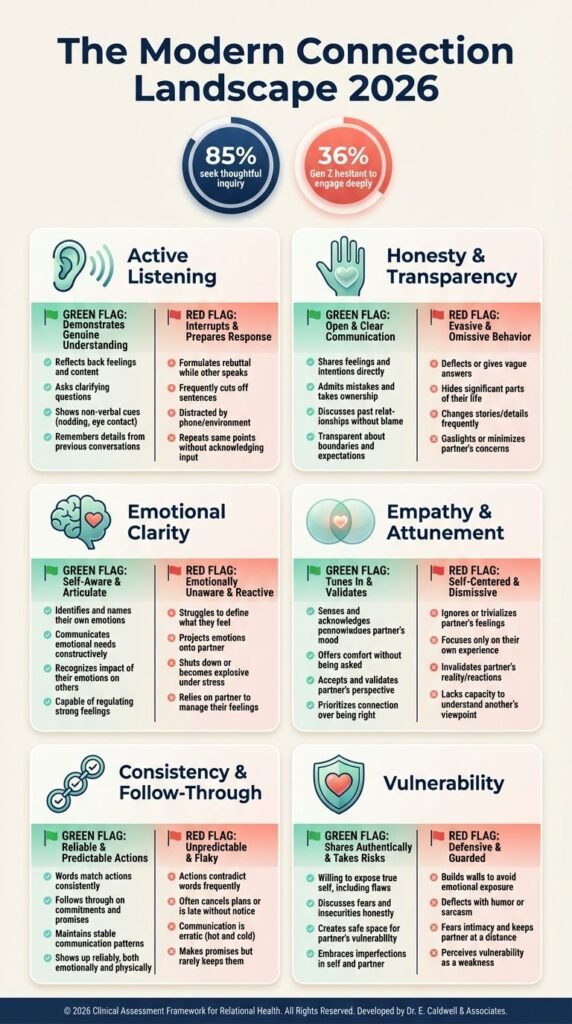
Did you know that 85% of daters say they’d be more likely to pursue a second date if someone asked them thoughtful questions? Yet 36% of Gen Z are more hesitant than millennials to initiate deeper conversations, even though they desperately want them.
This is the Communication Gap, and it’s reshaping modern dating.
Dating culture has fundamentally shifted. Five years ago, playing it cool and maintaining mystery was the unwritten rule. Today, that approach is dead. Singles in 2026 are rejecting ambiguity and embracing clarity. They want partners who say what they mean, follow through on plans, and create space for vulnerability.
Why does this matter? Because communication directly predicts relationship success. Research shows that couples who communicate clearly report higher satisfaction, resolve conflicts faster, and build deeper intimacy. Conversely, poor communication is the #1 predictor of breakups.
The stakes have never been higher. You’re swimming through dating apps, meeting dozens of potential matches, and trying to figure out quickly who’s worth your time. The answer lies in one skill: recognising a good communicator before you waste months on someone who isn’t.
Here’s what we’ll cover: what good communication actually looks like, six observable traits to assess, how to spot red flags within the first three dates, how attachment styles affect communication compatibility, and the specific tactics to improve your own communication.
What IS a Good Communicator? Separating Myth From Reality
Most people think a good communicator is someone who talks well. They’re charismatic, articulate, and never run out of things to say.
That’s backwards.
A good communicator is someone who listens well. They ask thoughtful questions, remember details about your life, and respond with genuine interest rather than waiting for their turn to talk. They’re not necessarily smooth or polished. They’re often quiet. But when they speak, it matters.
Here’s what good communication in dating actually requires:
| Good communicators are always articulate | They prioritize understanding over eloquence |
| Communication is about impressing someone | It’s about creating safety and clarity |
| Good communicators never get uncomfortable | They’re willing to be vulnerable and honest |
| The more you talk, the better the connection | Deep listening creates deeper connection |
| Communication is about words | It’s equally about follow-through and consistency |
Good communicators create psychological safety. When someone truly listens and responds with empathy, you feel safe being yourself. That safety is the foundation of intimacy.
They also follow through on what they say. If they say they’ll text you tomorrow, they do. If they suggest dinner on Friday, they confirm Thursday. This consistency isn’t just attractive, it’s the primary signal that someone respects you and the developing relationship.
Finally, good communicators are honest about their feelings and intentions. They don’t play games. If they’re interested, you know it. If they need space, they say so. This clarity, while sometimes uncomfortable, is infinitely more valuable than mixed signals and confusion.
The 6 Core Traits of a Good Communicator in Dating
When assessing someone’s communication style, watch for these six observable traits. They appear from the very first conversation.
Trait #1: Active Listening
Green flag: They ask follow-up questions. You mention your job, and they ask what you find challenging about it. You talk about a hobby, and they remember it three weeks later and ask how it’s going.
Red flag: They talk over you, check their phone mid-conversation, or respond to your stories with stories about themselves.
Active listening isn’t just staying quiet. It’s asking questions that show genuine curiosity. It’s remembering details and circling back to them. It’s responding to what you said, not what you were planning to say next.
The best communicators do this naturally. It feels like they genuinely care about understanding you because they do.
Trait #2: Honesty & Transparency
Green flag: They’re clear about their intentions from the start. “I’m looking for something serious”, or “I want to take this slow.” They don’t play games about how often they’ll contact you.
Red flag: They’re vague about what they want. They give mixed signals. They say they’re interested but rarely initiate contact.
Good communicators don’t make you guess. They’re not afraid to be honest, even when it is uncomfortable. If they’re not feeling a spark, they say so. If they want to see you again, they make plans. If something bothers them, they bring it up respectfully.
This honesty actually creates attraction because it signals confidence and respect.
Trait #3: Emotional Clarity
Green flag: They can articulate how they’re feeling. “I’m nervous about this conversation, but I think it’s important”, or “I’m really excited to see you.” They use emotion vocabulary.
Red flag: They shut down when emotions surface. They say “I’m fine” when clearly something’s wrong. They can’t name what they’re feeling.
People who can identify and express their emotions are more likely to communicate effectively overall. They can navigate conflict without blowing up or going silent. They can express vulnerability without it overwhelming them.
This matters early on because it predicts how they’ll handle future challenges together.
Trait #4: Empathy & Attunement
Green flag: When you share something difficult, they respond with genuine concern. They ask follow-up questions to understand. They adjust their behaviour based on your needs.
Red flag: They dismiss your feelings. They minimise your challenges. Conversations are always about them.
Empathy is the ability to recognise another person’s emotions and respond appropriately. It’s noticing you seem stressed and asking what’s going on. It’s scaling back plans after a rough week. It’s validating your feelings rather than arguing against them.
If someone can’t demonstrate basic empathy in early dating, they won’t develop it later.
Trait #5: Consistency & Follow-Through
Green flag: Their words match their actions. If they say they’ll text, they do. If they suggest plans, they schedule them. Their communication frequency stays relatively steady.
Red flag: They’re hot and cold. Intense attention followed by silence. Promises they don’t keep. You can’t predict when they’ll contact you.
Consistency is a communication superpower in dating because it signals respect and reliability. It shows that what they say actually matters to them.
Track this over three to four weeks. Does their pattern feel reliable? Or are you left wondering where you stand?
Trait #6: Vulnerability
Green flag: They share appropriate personal information. They’re willing to discuss feelings, challenges, or dreams. They admit when they don’t know something.
Red flag: They’re completely guarded. Never share anything personal. Never admit uncertainty or struggle.
Vulnerability isn’t oversharing on a first date. Appropriate self-disclosure creates reciprocal openness. When someone shares something real with you early on, they’re testing the waters. They’re asking: “Is it safe to be real with you?”
If you respond with openness and care, you signal that it is safe. That builds trust and intimacy.
How to Assess If Someone IS a Good Communicator (First 3 Dates Framework)
You now know what to look for. But how do you actually assess someone systematically, without overthinking every interaction?
Use the First 3 Dates Framework:
Date 1: Notice the Conversation Flow
Pay attention to who’s doing the talking. Ideally, it’s roughly balanced. Not exactly 50/50 (that’s robotic), but close.
Notice whether they ask questions about you. Not forced interview-style questions, but genuine curiosity about your life, work, and interests.
Observe their body language. Are they making eye contact? Leaning in? Or looking at their phone? Is their facial expression engaged?
Listen to the speed of responses. Do they respond to your statements quickly and naturally? Or do they seem distracted?
After the date, did they reach out? Same-day or next-day is the baseline for genuine interest in early dating.
Date 2: Watch for Patterns
By date two, you have more data. Patterns start to emerge.
Did they remember something you said on date one and ask a follow-up question about it? This is gold. It proves they were actually listening, not just waiting for their turn.
Are they becoming more comfortable sharing personal information? Or are they still fully guarded?
How do they respond when you share something vulnerable? With curiosity and care? Or dismissiveness?
Most importantly: did they follow through on what they said? If they suggested a restaurant, did they book it? If they said they’d send you a song, did they? This is where the real assessment happens.
Date 3: Look for Consistency
By date three, the pattern is clear. Either they’re consistently showing up as a good communicator, or they’re not.
Have they maintained contact between dates? Or have you had to initiate everything?
When you bring up a potentially uncomfortable topic (even something minor), how do they respond? Do they engage thoughtfully? Shut down? Get defensive?
The follow-up test is most revealing: Did they suggest a fourth date? With specific plans? Or are you still wondering where things stand?
The Follow-Up Test (Most Reliable)
Here’s the simplest assessment tool: What happens after the date?
In early dating (first 4 weeks), genuine interest shows up as:
- A message within 24 hours after the date
- Warm, specific tone (reference something from the date)
- Clear suggestion for next meeting with a timeframe
- Consistent pattern across multiple dates
If you’re seeing delayed responses, vague replies, or a pattern of you initiating while they react, they’re either not interested or poor communicators. Either way, that’s your signal.
Communication Styles & Attachment: Why You May Not Be On the Same Page
Here’s the nuance everyone misses: good communication looks different depending on attachment style.
Your attachment style is how you relate to others in close relationships. It shapes your communication needs and patterns. Most people fall into one of three categories:
Secure Communicators
Secure people are comfortable with both closeness and independence. They regularly initiate contact, but don’t panic if their partner takes time to respond. They express needs clearly without neediness or aggression.
Communication pattern: Consistent but flexible. They expect daily contact when dating, but don’t spiral if a day passes without texting. They can discuss feelings directly and don’t avoid difficult conversations.
In dating, they’re the dream date because they create space for you to be yourself while showing consistent interest.
Anxiously Attached Communicators
Anxious people crave frequent connection and reassurance. They interpret silence as rejection. They need explicit confirmation of interest and plans.
Communication pattern: They initiate frequently. They may text multiple times per day. They interpret delayed responses as personal rejection when they don’t hear from someone, and anxiety spikes.
In dating, they often come across as intense or needy early on, which can overwhelm avoidant or secure partners. But with another anxious or secure partner who communicates frequently, they thrive.
Avoidantly Attached Communicators
Avoidant people value independence and autonomy. They can feel suffocated by frequent communication. They struggle with emotional vulnerability and often withdraw when relationships get close.
Communication pattern: They initiate less frequently. They prefer space between interactions. They may seem uninterested, but they’re actually just uncomfortable with intensity. They often avoid deeper emotional conversations.
In dating, they can appear aloof or disinterested, which confuses anxious partners. But with a secure partner who doesn’t push too hard, they can open up over time.
When Styles Clash
The most significant mismatch is anxious-avoidant. An anxious person needs reassurance; an avoidant person withdraws from intensity. The more the anxious person pursues, the more the avoidant person distances. Both feel misunderstood.
This doesn’t mean it can’t work. It means you need an explicit conversation about communication needs. An anxious person might say: “I feel more secure with daily contact. Can we aim for at least one check-in per day?” An avoidant person might respond: “I need space and can feel overwhelmed with too much texting, but I can do that.”
The key question: Is the other person willing to meet you partway?
Secure communicators can usually flex to accommodate different needs. Anxious and avoidant people can too, but it requires conscious effort.
If someone refuses to discuss communication preferences or dismisses your needs as “too much,” that’s a red flag regardless of attachment style.
Digital Communication & the Gen Z Communication Gap: Navigating Text, Emojis & Response Times
Dating in 2026 happens primarily through text. Calls are rare. Texting is where you learn someone’s real communication style.
Texting as Communication
The same traits apply in text as in person:
Good texting:
- References something from your conversation
- Asks questions rather than just making statements
- Responds promptly (same day minimum)
- Uses appropriate warmth (emoji, tone indicators like “haha” or “😊”)
Poor texting:
- Generic responses (“cool,” “lol”)
- No questions; one-directional
- Delayed responses without explanation
- Cold tone; devoid of personality
Text gives you even more information than in-person because it’s lower stakes. Someone who puts effort into their texts is signalling: “I’m thinking about you. This matters to me.”
Someone who sends one-word responses? They’re signalling: “This is convenient for me, but I’m not investing energy.”
Response Times & What They Signal
Response time matters less than consistency.
Someone who responds in 30 minutes every time is different from someone who sometimes responds immediately and other times takes 8 hours. Consistency signals genuine interest.
In early dating (first 2-3 weeks), expect responses within:
- Daytime responses: 2-4 hours
- Evening messages: next morning
Why? Because if someone is interested and has their phone (which they do), they’ll see your message and respond in a reasonable timeframe. This isn’t about being glued to your phone; it’s about prioritising communication with someone you like.
After 4+ weeks of regular dating, patterns vary more based on work and life. But that baseline? That’s normal for people who genuinely like each other.
Emoji & Tone Interpretation
Here’s something most articles skip: emojis actually reduce misunderstandings in text.
Text is 7% words, 93% tone when delivered in person. In text, you lose that tone entirely. Emojis fill that gap.
Compare these two texts:
“I had a great time tonight”
“I had a great time tonight 😊”
“I had a great time tonight.”
Same words. Three completely different emotional tones. The first feels neutral or cold. The second feels warm. The third feels formal or distant.
People who text well use emojis thoughtfully to convey warmth. It’s not mandatory, but it signals emotional attunement, and they’re aware that tone matters in text and they’re compensating for the lack of facial expression.
The Gen Z Hesitation
Here’s the reality Gen Z faces: They want deeper conversations but are terrified to initiate them.
The research is detailed. Hinge data shows 84% of Gen Z want meaningful connections. But 36% are more hesitant than millennials to start deeper conversations. Why?
Social anxiety, perfectionism, and fear of being too much. The irony: the very vulnerability that creates connection is what they’re most afraid of.
If you’re Gen Z and struggling with this, here’s the gap-closer: Start with low-stakes vulnerability in text. Don’t wait for the perfect moment or the right words.
Try:
- “I’m a little nervous about dating, but I’m trying to be brave”
- “I really enjoyed talking with you. I’d like to see you again”
- “I’m usually more guarded, but something about you makes me want to be honest”
You’re not oversharing. You’re signalling that you’re a real person with real feelings. People respond to that. The “right” person will too.
From Texts to Voice Calls
Here’s an underrated signal: someone who suggests a phone call or video chat is taking things seriously.
Text is safe and low-stakes. A voice call requires real-time presence and vulnerability. If someone suggests a call, they’re escalating investment.
If someone resists calls entirely while maintaining regular texts, that’s a pattern worth noting. It might indicate they’re not as invested or they’re uncomfortable with real-time connection.
How to Be a Better Communicator: Practical Steps to Improve Your Own Communication
Assessment is one-half of the equation. Improvement is the other.
If you recognise that you struggle with communication, the good news is that these are learnable skills. You don’t need to be naturally charismatic or extroverted. You need consistency, intention, and practice.
Skill #1: Listen to Understand, Not to Respond
Most people listen while planning what they’ll say next. That’s not listening; that’s waiting.
How to fix it: When someone is talking, pause your internal conversation. Listen to understand what they’re saying and feeling. When they finish, take a breath before responding. This one pause changes everything.
The pause signals that you were actually present with what they said, not just running your mouth.
Skill #2: Ask Thoughtful Follow-Up Questions
Good communicators aren’t necessarily the most interesting people. They’re the most interested people.
When someone shares something, the follow-up question reveals if you were listening:
Poor follow-up: “That’s cool. My job is stressful too.”
Good follow-up: “What part of that project is most stressful? How long have you been feeling this way?”
You’re not interviewing them. You’re showing curiosity about their experience. The difference is subtle, but everything to someone.
Skill #3: Be Clear About Your Intentions & Feelings
Ambiguity kills relationships early on.
Instead of: “I like spending time with you” (vague)
Try: “I’m really enjoying getting to know you, and I’d like to keep seeing you” (clear)
Instead of: “That’s fine” (when it’s not)
Try: “I’m frustrated about this, and I want to talk about it” (honest)
Clarity feels vulnerable in the moment. But it builds trust faster than weeks of careful ambiguity.
Skill #4: Follow Through on What You Say
This is the most straightforward and most powerful communication skill.
If you say you’ll text them tomorrow, do it. If you suggest dinner on Friday, follow up on Thursday to confirm. If you commit to something, deliver on it.
This one behaviour alone transforms how people perceive your communication, proving that your words mean something.
Skill #5: Show Genuine Curiosity About Their Life
Ask about their work, their family, and their interests. Then actually listen to the answer.
Most people wait for others to ask about them. Flip the script. Ask first. Ask follow-ups. Remember details and reference them later.
You want someone to care about your life? Show you care about theirs first.
Skill #6: Be Vulnerable (Appropriately)
Vulnerability is not oversharing on a first date. It’s appropriate self-disclosure that matches the relationship stage.
On a first date: Share why you’re attracted to a particular hobby or what you’re hoping to find in dating.
By date 3-4: Share a personal challenge you’re working through or something you’re uncertain about.
By date 6+: Share deeper fears, dreams, or family dynamics.
Vulnerability creates intimacy when it’s matched. When one person shares something real, and the other responds with openness, it signals: “This is a safe person.”
Red Flags: Communication Patterns That Signal Trouble
Not every miscommunication is a red flag. But patterns are.
Watch for these specific patterns. If you see more than one, listen to your gut.
Red Flag #1: Defensive Communication
When you bring up even a minor concern, they get angry or blame you.
Example: “I noticed you didn’t reach out after our date, as you said. That made me feel uncertain.”
Defensive response: “You’re too needy. Why are you always making a big deal out of nothing?”
Healthy response: “You’re right, I dropped the ball. I was slammed at work, but that’s not an excuse. I’ll do better.”
People who consistently get defensive can’t hear feedback. That’s a huge problem in relationships.
Red Flag #2: Inconsistent or Dishonest
Their stories change. They say one thing to you and something different to friends. You catch them in small lies about where they were or who they were with.
Dishonesty early is a preview of dishonesty later. And it prevents real intimacy because you can’t trust them.
Red Flag #3: Dismissive or Contemptuous
They make fun of your opinions, interests, or goals. They don’t take your feelings seriously. When you’re upset, they mock you rather than care.
Contempt is one of the strongest predictors of relationship failure. If someone doesn’t respect you, the relationship won’t survive.
Red Flag #4: No Follow-Through
You’ve had a conversation about wanting more communication. Nothing changes. You’ve made plans multiple times, only for them to be cancelled. You’re always the one initiating.
Words without action tell you everything. Trust the pattern.
Red Flag #5: Love Bombing Then Withdrawal
They’re intensely interested and attentive for 2-3 weeks. Then they pull back dramatically. You’re left confused and wondering what happened.
This cycle can repeat. Hot and cold. All in, then gone.
People who do this are either avoiding intimacy or testing your emotional boundaries. Neither is healthy.
Red Flag #6: Unwillingness to Clarify or Label
You’re dating for multiple weeks, and they refuse to discuss what this is. “Let’s just see where it goes” becomes their constant answer. When you express that you need clarity, they get uncomfortable or evasive.
Communication about communication matters. If someone won’t clarify intentions after multiple weeks, they’re keeping options open while you’re investing.
Frequently Asked Questions About Communication in Dating
How often should you text someone you’re dating?
Depends on attachment style and relationship stage. But consistency matters more than frequency.
In the first 2-3 weeks, most new daters expect contact 3-5 days a week, plus regular texting between dates. “Some” means 2-3 exchanges daily, not constant texting.
After exclusivity (1-2 months in): Daily contact becomes normal. This might be a morning check-in, something during the day, and an evening conversation. Again, not constant, but consistent.
The baseline: If someone is interested and has their phone, they’ll reach out. Regularly.
What if my communication styles are entirely different?
Difference isn’t a dealbreaker. Willingness to understand is.
Secure communicators can flex to meet anxious or avoidant partners partway. Anxious and avoidant people can too, but it requires conscious effort and honest conversation.
The question to ask: “When I express my communication needs, does this person take it seriously and try to meet me halfway?” If yes, you can work with different styles. If they dismiss your needs or refuse to adjust, that’s an incompatibility.
Is ghosting a communication problem or a character problem?
Both.
Ghosting signals two things: first, the person couldn’t communicate their feelings or lack of interest clearly. Second, they didn’t respect you enough to deliver that message.
It’s never a reflection on you. It’s always a reflection on them.
Should I bring up communication issues directly on early dates?
Not on a first date. By date 3-4, if you sense misalignment, a gentle conversation works: “I’m really enjoying getting to know you, and I want to make sure we’re on the same page about how often we’re connecting. What’s your preference?”
This isn’t confrontational. It’s clarifying. And it reveals whether they’re willing to have honest conversations.
How do I know if I’m being too needy or if they’re being avoidant?
Ask yourself:
- Do they ever initiate contact? Or do you always go first?
- When they do respond, is their tone warm or lukewarm?
- Do they suggest plans? Or do you always suggest?
- Do they follow through when they say they will?
- Have they made an effort to introduce you to their life (friends, routines, schedule)?
If most answers are no, they’re likely not as invested, or they’re avoidant. Either way, that’s your answer.
Can someone improve their communication skills if they’re naturally shy?
Absolutely.
Shyness is not poor communication. Shy people often make the best communicators because they think before speaking and listen carefully.
Communication skills are about consistency, honesty, and follow-through, not volume. A shy person who texts reliably and shows genuine interest is a good communicator. An extrovert who talks constantly but never listens is not.
Is it a red flag if someone doesn’t like video calls?
Not necessarily. Some people prefer texting or in-person. That’s just preference.
But if someone avoids ALL forms of real-time communication calls, video, in-person, while consistently texting, that suggests avoidance. They like the control that texting provides without the vulnerability of real-time interaction.
After a few weeks of dating, a real-time connection should happen regularly.
Conclusion
Good communicators aren’t born; they’re people who listen, ask questions, follow through, and show up honestly.
The real power isn’t finding a perfect communicator. It’s building mutual understanding with someone willing to work on communication together.
If you’re looking for a partner, use the six-trait framework and the first-date assessment to quickly determine whether someone is worth your time. If you’re trying to improve your own communication, start with one skill, probably active listening and build from there.
Dating in 2026 is shifting away from games toward genuine connection. By understanding communication deeply in others and yourself, you’re already ahead.
Ready to better understand your own communication style? Download our free Communication Style Discovery Guide and get personalised insights into how you show up in dating. Join our newsletter for instant access.
The best relationships aren’t built on perfect communication. They’re built on people brave enough to communicate honestly, even when it’s scary.