

Why Do Men Dislike Valentines Day
Be honest: have you ever asked yourself, “Why do men dislike Valentine’s Day?”
He seems fine.
You ask about plans for the 14th, and he says, “Whatever you want to do.” You hear indifference. You might even hear laziness.
But that’s not what’s happening.
What looks like not caring is, for many men, the opposite. It’s caring so much about getting it right that the whole thing locks up. The planning, the gift, the dinner, the unspoken expectation that one evening will somehow prove what 364 other days apparently couldn’t.
This article is built on psychological research into masculinity, gender role socialisation, and what actually drives wellbeing in relationships. It’s written for you, but it’s about him. What he feels, why he can’t say it, and what genuinely helps.
The performance he never signed up for and this is Why Men Dislike Valentines Day
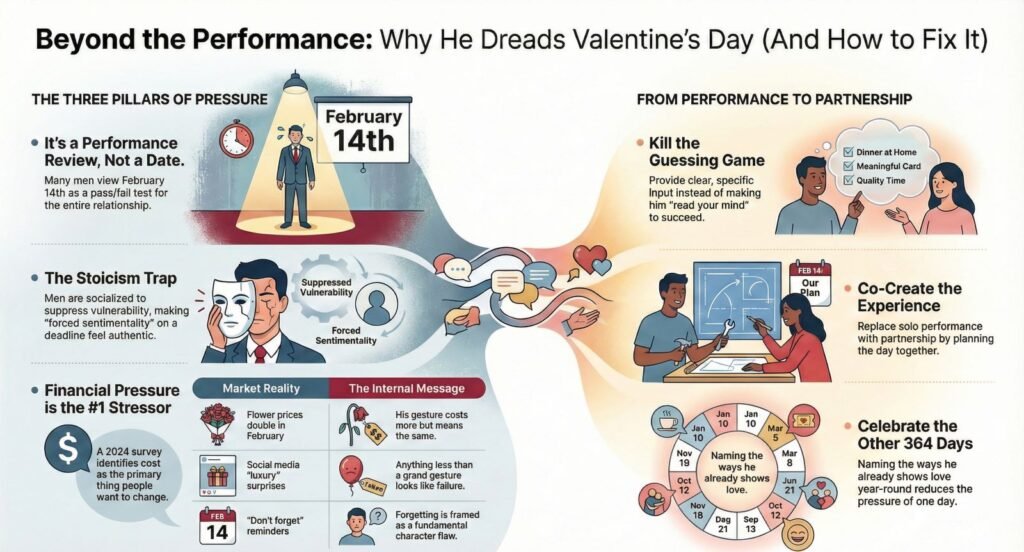
Here’s the thing most men won’t articulate: Valentine’s Day doesn’t feel like a celebration to them. It feels like a performance review.
Not a casual one. The kind where your score gets discussed by people who weren’t in the room.
It’s not one evening, it’s an exam
Many men feel that February 14th is a pass/fail test for the entire relationship. Not “did we have a nice time together?” but “did he do enough?” That framing changes everything. It turns affection into a deliverable.
When love becomes something you’re graded on, spontaneity dies. What replaces it is anxiety.
The invisible audience
He knows that what he does on Valentine’s Day won’t stay between the two of you. Your friends will ask. Your coworkers will compare. Someone will post something on Instagram that makes whatever he planned look small.
He’s not just trying to make you happy. He’s trying to survive Monday morning when someone at your office says, “So what did he do?”
That audience is invisible to him but very real. And it raises the stakes far beyond a dinner reservation.
The bar that rises every year
Whatever he did last year becomes the new minimum. If he took you to a nice restaurant, this year needs to be nicer. If he surprised you, this year’s surprise needs to be bigger. The escalation has no ceiling.
Men who have been in relationships for several years often describe this as a treadmill. Not because they don’t want to show love, but because the definition of “enough” keeps shifting upward.
“It’s not that I don’t care. It’s that no matter what I do, I feel like I should have done more.”
That sentence, or some version of it, comes up over and over again in research on men and Valentine’s Day pressure.
The emotional bind he can’t talk about
Underneath the logistical stress, there’s something quieter and more complicated to name. Valentine’s Day asks men to do the exact thing they’ve been trained since childhood not to do: be emotionally open, on a deadline, in public.
Socialised to suppress
Boys learn early which emotions are acceptable. Anger is fine. Frustration, sure. But tenderness, nervousness, sadness, longing? Those get corrected. Sometimes with words, sometimes with silence, sometimes with mockery.
The American Psychological Association’s guidelines on men and boys describe this pattern clearly: traditional masculine socialisation encourages suppressing emotions other than anger and avoiding anything coded as vulnerable or feminine. This doesn’t switch off because it’s February.
A man who has spent decades building walls around vulnerability doesn’t suddenly become a poet because Hallmark says he should.
Vulnerability on a deadline
There’s a difference between choosing to be emotionally open and being expected to perform emotional openness on a specific calendar date.
The first feels intimate. The second feels like a trap.
Men who value authenticity often find forced sentimentality worse than no sentimentality at all. It’s not that the feeling isn’t there. It’s that packaging it on command strips it of what made it real.
The stoicism trap
This creates a bind with no clean exit:
- If he says he doesn’t care about Valentine’s Day, he sounds cold.
- If he admits the pressure makes him anxious, he feels exposed.
- If he goes through the motions without feeling it, he feels fake.
Pick one. None of them feels good.
The money problem nobody wants to mention
Then there’s the financial layer. And it’s heavier than most women realise.
Love measured in dollars
Valentine’s Day operates on an unspoken equation: the size of the gesture equals the depth of the feeling: a bigger dinner, a better gift, a more expensive experience = more love.
Men know this equation. They don’t believe it, but they know you might. Or that your friends might. Or that the culture certainly does.
A 2024 survey found that financial pressure is the number one thing people want to change about Valentine’s Day. Not the crowded restaurants. Not the cliched gifts. The money.
The commercialisation trap
Flowers cost more in February. Restaurant prix fixe menus appear that didn’t exist on February 7th. Jewellery ads run on every platform for six straight weeks.
Men aren’t imagining this. The entire commercial ecosystem around Valentine’s Day is designed to make them feel that buying less means loving less.
| Flower prices double the week before | His gesture costs more but means the same |
| Every ad targets “for her” gifts | He’s the one expected to spend |
| Social media filled with luxury surprises | Anything less looks like he didn’t try |
| “Don’t forget Valentine’s Day” reminders everywhere | Forgetting is framed as a character flaw |
The guilt of “not enough”
The deepest cut isn’t the cost itself. It’s the fear that a thoughtful but inexpensive gesture will be interpreted as cheap. Making dinner at home signals less love than a £200 restaurant. That a handwritten note means less than a necklace.
He may not say this. He may just quietly put it on the credit card and feel the squeeze in March.
What masculinity has to do with February 14th
All of the above, the performance pressure, the emotional bind, the financial stress, connect to something bigger: how men are taught to be men.
The role he was handed
Psychology treats masculinity as something learned, not something fixed. Boys absorb messages about what “real men” do from fathers, peers, coaches, movies, and the broader culture. Those messages typically centre on a few themes: be strong, don’t show weakness, provide, protect, achieve, and never appear feminine.
Valentine’s Day activates this script in contradictory ways. He’s supposed to be strong, but also tender. A provider, but the spending feels coerced. In control, but following someone else’s expectations.
The conflict isn’t conscious for most men. It shows up as irritability, avoidance, or that flat “I don’t really care about Valentine’s Day” that sounds like apathy but is actually overload.
Multiple masculinities, one holiday
There is no single version of manhood. Research consistently shows that masculinity varies across cultures, communities, religions, economic classes, and family histories.
An African American man might define manhood through being “God-fearing, a protector, a provider, kind but stern.” A man from a Scandinavian background might emphasise equality and emotional availability. A man raised in a working-class family might centre on reliability and sacrifice.
All of them walk into the same Valentine’s Day and face the same narrow script: buy flowers, book a restaurant, say something romantic, don’t mess it up.
One holiday cannot hold all those versions of love. When it tries, someone always feels like they’re doing it wrong.
The expectation-reality gap
Psychologists call this cognitive appraisal. When a man’s internal sense of what he can authentically deliver collides with what’s expected of him externally, the gap creates stress. If the gap is small, he adapts. If the gap is wide, he withdraws.
That withdrawal looks like not caring. It is the opposite.
What he actually needs (according to psychology, not Hallmark)
Self-determination theory identifies three universal psychological needs: autonomy, competence, and relatedness. When these are met, people function well. When they’re blocked, people struggle.
Valentine’s Day, as currently constructed, blocks all three for most men.
Autonomy: let him love you his way
Autonomy means acting from your own values, not someone else’s script. When love has to look a certain way, arrive on a specific date, and meet a standard set by culture and commerce, it stops feeling like his.
A man who shows love by fixing things, by being steady, by showing up when it’s hard, is no less loving than a man who writes poetry. He’s loving differently. Valentine’s Day rarely makes space for that.
What he needs: permission to express love in a way that feels real to him, not a way that looks right to everyone else.
Competence: stop the guessing game
Competence means feeling capable and effective. The Valentine’s Day guessing game, where he’s supposed to read her mind and select the perfect gesture without any input, is designed to make him feel incompetent.
“Just tell me what you want” isn’t him being lazy. It’s him trying to succeed instead of being set up to fail.
When you say, “I don’t care, anything is fine,” he doesn’t hear easy-going. He hears “there’s a right answer and you’re supposed to know it.”
What he needs: clear, specific input about what would actually make you happy. That’s not unromantic. It’s the most helpful thing you can give him.
Relatedness: make it about connection, not performance
Relatedness means feeling genuinely close to someone. Performance kills closeness. When one person is performing, and the other is evaluating, that’s not intimacy. That’s a stage.
The Valentine’s Days that men describe as good, the ones they actually enjoyed, almost always have one thing in common: both people were present, relaxed, and focused on each other. Not in the restaurant. Not in the photo. Not on what anyone else would think.
What he needs: a version of February 14th where both of you feel closer at the end, not one where he performed, and you scored.
Five things you can do before February 14th
This is where theory becomes practice. None of these is complicated. All of them change the dynamic.
Tell him what you actually want. Remove the guessing game entirely. “I’d love to cook together and watch a movie”, gives him something to work with. “Whatever you want” gives him a minefield to navigate.
Ask him what would make the day feel good for him. Most men have never been asked this question about Valentine’s Day. Not once. The question alone communicates that his experience matters, which is half of what he needs.
Co-create the plan instead of waiting to be impressed. Planning together replaces performance with partnership. It takes the pressure off him and gives you more of what you actually want. Two people building something together is more romantic than one person performing for the other.
Lower the public stakes. Skip the Instagram post. Don’t debrief with your group chat on the 15th. Keep whatever happens between the two of you. When the audience disappears, the pressure drops and what’s left is real.
Name how he already shows love the other 364 days. He drove an hour to pick up your prescription. He sat with you when you were anxious and didn’t try to fix it. He remembered that thing you said three months ago. Say those things out loud. Before February 14th, tell him you see it. That single act may mean more to him than anything that happens on the day itself.
The bigger picture: what Valentine’s Day reveals about your relationship
Valentine’s Day doesn’t create problems in a relationship. It magnifies the ones already there—the communication gaps, the unspoken expectations, the imbalance in who carries the emotional and logistical weight. February 14th turns the volume up.
Valentine’s Day is a magnifying glass.
If there’s a pattern where he guesses and you evaluate, Valentine’s Day will make that pattern louder. If there’s a pattern where his way of showing love goes unrecognised, Valentine’s Day will make that sting worse.
The good news: fixing the dynamic for Valentine’s Day often fixes it everywhere else, too.
Healthy masculinity is a relationship asset.
When a man feels free to define what being a good partner means on his own terms, without performing someone else’s script, both people benefit. He becomes more present, more honest, more generous. Not because he was forced to, but because the space was there.
Psychology calls this authentic autonomy. It just means letting him be himself and loving what that looks like.
The couples who get this right
They don’t skip Valentine’s Day. They make it theirs. It could be breakfast instead of dinner. It could be a hike instead of a restaurant. Maybe it’s a conversation on the couch that goes somewhere real.
The form doesn’t matter. What matters is that both people feel seen.
Questions women ask about men and Valentine’s Day
Do men actually care about Valentine’s Day?
Most do, but not in the way the holiday packages it. They care about the relationship. The holiday itself often feels like a pressure test rather than a celebration. His silence around February is usually not indifference. It’s an overload.
Why does he always seem to leave it to the last minute?
He probably hasn’t. Many men report thinking about Valentine’s Day for weeks, stuck between options because the fear of getting it wrong is louder than the excitement of getting it right. What looks like procrastination is often paralysis.
Is it wrong to want a romantic Valentine’s Day?
Not at all. The issue isn’t wanting romance. It’s when romance is defined so narrowly that only one person carries the burden of producing it. The best Valentine’s Days are ones where both people contribute to the experience.
What if he genuinely doesn’t want to do anything?
Some men carry painful associations with the day. Bad breakups, humiliation, and financial stress made past Valentine’s Days miserable. If he says he doesn’t want to do anything, the question worth asking is what’s behind that. The answer usually matters more than the day itself.
How do I bring this up without making him defensive?
Lead with what you’ve noticed, not what you need. “I’ve noticed you seem tense around Valentine’s Day. What would make it feel good for you?” is a different conversation than “Why don’t you ever plan anything?” The first opens a door. The second closes one.
Where to go from here
Valentine’s Day pressure isn’t about laziness or indifference. It’s the collision between what men have been socialised to suppress and what the holiday demands they perform, in public, on a deadline, with a scorecard.
The men who struggle most with Valentine’s Day are often the ones who care the most about getting it right. That’s worth sitting with.
Understanding this isn’t a February hack. It’s a relationship skill: seeing how masculinity shapes his behaviour and making room for him to show love in a way that’s actually his own.
If this resonated and you want to go deeper into how he thinks about attraction, connection, and what keeps him invested in a relationship, [this resource] goes further than one article can. It’s built around the psychology of how men experience love, not how they’re told to perform it.
The best thing you can do before February 14th isn’t plan the perfect evening. It’s let him know he doesn’t have to be perfect to be enough.